
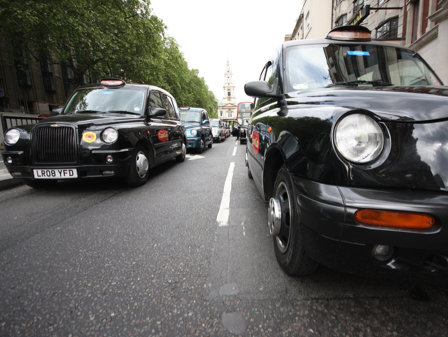
Today, 10,000 London’s cabbies have staged a drive-slow through the centre of London beginning at Trafalgar Square with the aim of bringing the city to a standstill. The problem, an innocuous mobile app. ‘Uber Taxi’ allows users to conveniently find and book nearby taxi drivers using smartphones. It has proved extremely popular and reduced fares as anyone with a private hire vehicle licence can become a driver. Cabbies are feeling squeezed. The London Taxi Drivers’ Association has already launched legal action against several ‘Uber Taxi’ minicab drivers, claiming that the app is merely a meter that private hires are unable to use without breaking the law.
This furore is merely a microcosm of much wider issues that will dominate the years ahead. In the future, the potential implications of self-driving cars, robot-driven surgery and the like leaves the mind to wonder if there will much left for human beings to do. The impact of mechanisation coupled with outsourcing to foreign countries has created increasing uncertainty surrounding the employment prospects of white-collar workers traditionally immune to such problems. The substitution of capital for labour has moved beyond manufacturing. As a result, we must be mindful of the sharp and permanent disruptions to the labour market and the propensity to accelerate existing trends of inequality and falling wages. While others flounder, holders of capital alongside those able to find high-wage work and the beneficiaries of rising corporate profit margins will certainly prosper.
I argue that it would be difficult to reject progress or the process of innovation, and this would not be desirable. Arguments stated previously should not be mistaken for a Luddite rejection of industrial progress. Greater life outcomes and happiness for all of us have been and will continue be hammered on the anvil of technological improvement. Optimistic for the future, in a recent article for the New Statesman, Stella Creasy suggested that ‘Instead of fearing change, we should build one nation where the rewards that flow from embracing change are shared by all.’
In terms of political responses, as efforts of forecasting far into the future appear nonsensical when viewed in retrospect, it would be impossible to predict the uncertainty that lies ahead. The only certainty is the uncertainty of the future. As a result, it is critical that any future Labour government continue to diversify the economy and to create robust and resilient foundations for economic prosperity that can help mitigate unforeseen structural changes. Thankfully, Labour Digital is helping to prepare Britain to weather this radical change by promoting ‘digital growth, skills, opportunity and collaboration to ensure that the UK leads the world in innovation and no one is left behind.’ Encouragingly, Chuka Umunna’s Agenda 2030 speaks about Labour’s priorities to invest in British science and further develop our national innovation system.
These big changes in the economy calls for an active government and industrial diversification in order to support changing demands for skills, education and capital alongside labour market regulation preventing a ‘race to the bottom’ in labour standards as the balance of power shifts increasingly to employers. Labour needs to build on the recent government report on the future of work and the left must react quickly with more plans and policies. In order to help maximise the opportunity for Britain, it will be the role of the government to ensure alignment between public and private investment in order to enhance the creation of jobs and economic prosperity. In order to win Ed Miliband’s ‘race to the top’, Labour must further improve the investment environment, allowing people and businesses to innovate and compete on a global basis in the high-knowledge sectors. A rejection of progress is a road to ruin. However, we must make every effort to ensure that technological growth is the engine for emancipation not immiseration. This is a tremendous opportunity for the country. If handled properly, the best of Britain is yet to come.
———————————
Oliver MacArthur works for the investment team at a charitable endowment. He tweets @olliemacarthur
———————————
In some ways the issues surrounding black cabs are a really good example of a service industry that will be transformed/destroyed (use own word of choice) by the changes in technology, but raise serious issues about regulation. The ‘knowledge’ is surely a relic of a bygone age as sat-nav and apps like Uber undermine the present licensing regime, and frankly the need to have all licensed cabs capable a turning circle suitable for the Savoy Hotel, is of another age. There is a need to ensure that both drivers and vehicles used are fit for purpose and that is the role that licensing should play – protecting the customers, not providers, and encouraging competition, not monopoly..
In the long run, Oliver MacArthur is right about technology and how it benefits society, but in the short run there are many, many losers. Luddites have a bad reputation, but at the time they probably felt they had no choice – they were defending their way of life, their community and their own and their families, well-being. Then they turned to smashing up machinery, now many in a similar position, turn to UKIP. The challenge for Labour is to provide answers for those affected by change, without resorting to saying no change