
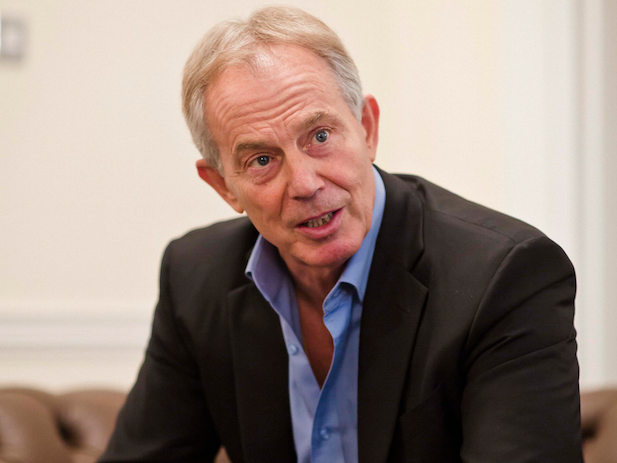
Tony Blair’s legacy is hotly contested. He defends it to Robert Philpot and Adam Harrison
The expected publication next year of the much-delayed Chilcot inquiry will reopen, if it ever closed, the debate about Britain’s most controversial foreign policy action since Suez: the decision to join the United States in the overthrow of Saddam Hussein in 2003.
But, as the man at the centre of that debate recognises, Iraq is not simply a matter of bitter controversy upon which historians will have to render a judgement. The fallout from the choice Tony Blair made nearly 12 years ago rests at the heart of current arguments about who is to blame for the rise of Islamic State and how Britain responds to it.
Blair says he agrees ‘completely’ with the assessment of former foreign secretary David Miliband that Iraq ‘engendered a deep suspicion of intervention’, the consequences of which are apparent in the government’s reluctance to join the US and its allies in pursuing the campaign against Islamic State into Syria, as well as its insistence that there will be no British ‘boots on the ground’.
But while the former prime minister accepts that ‘we bear responsibility in part for Iraq as it is because we removed the dictatorship back in 2003’, he refuses to accept that the war caused the rise of Islamic State there. ‘The thing I’m challenging is the notion that if you’d left someone like Saddam there that things would have been easy. First, they wouldn’t have been, and, second, let’s not forget the reason these people came back out of Syria was when we didn’t intervene in that crisis.’ Blair notes that, while jihadis were ‘drawn into the arena’ in the aftermath of the invasion of Iraq, they had been ‘pretty much beaten’ by US and British forces by 2011.
He attacks ‘the myth at the heart of a lot of the thinking on the left’: that the Iraq war ‘created this problem’. Moreover, he says, ‘the ugly and unavoidable choice that we have is that you either deal with it by getting engaged with it, with all the difficulties that that implies, or you stay out. But … do not kid yourself that if you stay out the problem disappears.’ Blair cites the experiences of Iraq, Libya and Syria. In Iraq, he suggests, there was a demand that Saddam relinquish power, followed by military action and the deployment of troops afterwards. The result, he accepts, was ‘very difficult’. But, he continues, in Libya, ‘we called for Gaddafi to go, we used air power to make him go, we didn’t put troops in after. Libya today is a problem for the entirety of the Middle East and the northern part of Africa. In the case of Syria, we called for [Assad] to go, we didn’t use troops, and Syria is in a worse state than any of them.’
Blair reiterates his belief that Islamic State cannot be defeated by military action in Iraq alone. ‘You have to defeat them in Syria, too,’ he argues, and he wants to keep the possibility of Britain’s involvement in Syria ‘on the table’. ‘There may come a moment when it’s possible for us to do that; I hope that’s the case,’ he says. He also believes that Islamic State cannot be defeated without ground troops. ‘The question,’ Blair suggests, ‘is whose, and they don’t necessarily need to be ours.’ But, he adds, ‘I know these campaigns all change very fast … and we should keep our options open.’
Nonetheless, the former prime minister warns that the defeat of Islamic State will not mark the end of the battle against an extremism fought by what he terms ‘fanatics [who] are prepared to kill without mercy and die without regret’. Instead, he predicts a ‘generation-long struggle’ akin to the cold war, with which he sees ‘real similarities’. ‘In the sense that it requires a total commitment over a long period of time and it requires you both to have a security aspect [and] what I would call an ideological fightback, it’s very similar to the struggle against communism.’
Blair is frustrated that, for many Britons, Iraq effectively disqualifies him from contributing to this debate. He predicts, however, that this will change: ‘At some point … people will come to see that this is indeed a complicated and difficult argument and [that] this is something … I’ve spent not just my time in office but … the last seven years studying. I’m out in the Middle East twice a month, I’m seeing it first-hand. So when people say, “Oh, well don’t listen to him because of Iraq”, well, precisely because I’ve gone through these experiences it may just be that it’s worth at least listening to my reflections on them.’
Seven years as the representative of the Quartet – the informal diplomatic group established by the US, the European Union, Russia and the United Nations in 2002 to push the Middle East peace process and assist with Palestinian economic development and institution-building – do not appear to have sapped Blair’s optimism. Despite the war between Hamas and Israel during the summer, he detects ‘an opportunity of changing the situation in Gaza significantly and setting out a political horizon’ for Palestinian statehood. He criticises, however, the decision of Sweden’s new centre-left government to recognise a Palestinian state and Labour’s decision to whip its members of parliament to vote in favour of such a motion in last month’s debate in the House of Commons. ‘I understand people feel very frustrated about the situation [the] Palestinians find themselves in but the truth of the matter is that the only solution that will work is a negotiated settlement,’ he responds. ‘I think Israel would be very sensible to read the speeches in that debate and understand how strong the feeling is. But I know dealing with this issue day in, day out, there’s only one way you can resolve it and it’s not through resolutions in the UN or elsewhere, I’m afraid, it’s on the ground.’
Foreign policy is unlikely to be at the forefront of most voters’ minds when Britain goes to the polls next May. Nonetheless, another of Blair’s legacies – the decision to remove transitional controls and immediately allow migration into Britain from new EU member states such as Poland and Hungary in 2004 – is a major factor in the debate around immigration which has fuelled the rise of the United Kingdom Independence party. The former prime minister urges Labour not to give any ground to Nigel Farage. ‘Let’s be clear: We don’t think that Ukip’s right, not on immigration and not on Europe – so the first thing you’ve got to be really careful of doing is … saying things that suggest that they’re kind of justified in their policy because what you’re actually going to do is validate their argument when in fact you don’t believe in it,’ he says. He accepts the need to have rules around immigration – and says his support in office for identity cards stemmed from a belief that they were crucial for managing it – so that ‘the system doesn’t get abused and exploited, and you don’t end up with people feeling that they’ve lost control over their communities and their lives.’
But he is clear that stopping immigration would be ‘a disaster for this country’. Labour, he says, should not ‘end up chasing after the policies of a party like Ukip, who you don’t agree with, whose policies would take this country backwards economically, politically, in every conceivable way, and who, ultimately, at the heart of what they do, have a rather nasty core of prejudice that none of us believe in, which you’ve actually got to take on and fight. So the way to deal with this is to deal with it by what you believe.’
Blair also believes that David Cameron’s handling of the threat from Ukip is politically self-defeating. The Conservative party’s ‘Clause IV is Europe, and the fact that they haven’t dealt with it and have now allowed this thing to run away again with their party, it doesn’t do them any electoral favours at all.’ The former prime minister believes the Tories would attract more support ‘if they actually stood up against these people and said: “You don’t understand the way the world works today, your policies will take us backwards and we’re not going there”.’
Blair knows that his brand of third way politics is currently deeply unfashionable in some parts of the Labour party, even if it is undergoing something of a revival in an eclectic group of European centre-left parties. While it has been embraced by the prime ministers of France, Italy, Albania and Malta, Blair admits to being slightly startled when the Maltese prime minister recently told him he had worked as an intern on Labour’s 1997 campaign. Nonetheless, he is convinced that a third way emphasis on ‘strong values, but practical, non-ideological solutions’ is ‘definitely where people are’, even if, Blair says in a barely disguised reference to the party he led for 13 years, ‘it’s often not where political parties are because they want to appeal to their activists’. But, he argues, Labour should beware: ‘There’s a huge desire in a large part of the media in this country to return British politics to a traditional Tory party fighting a traditional Labour party.’ Such a contest, the only man who has led Labour to victory in the last 40 years concludes grimly, always results in ‘a traditional result’.
———————————
Photo: Paul Heartfield
Right on UKIP, very wrong on Iraq, right on Syria, wrong on Israel/Palestine.
Again and in vintage fashion, Tony Blair had provided two positions for the electorate to consider, which are untrue and deceptive respectively: (1) “stopping immigration would be ‘a disaster for this country’” and (2) “He accepts the need to have rules around immigration…”. (2) doesn’t and cannot exist within the EU and Blair knows it and (1) is hysterical nonsense.
That’s because he’s a self-delusional, narcissistic fantasist who can believe absolutely anything. While we all have the capacity to do that to an extent, to be completely unmoored from any sense of contradiction to the extent Blair is makes him dangerous in the extreme. What is sad is to to see a mangy rump of hagiographers who still hang on every word that drips from his double-speaking mouth. As you can probably gather, I don’t care for him a great deal. Rant over 🙂
If only your final comment were true!
Tony may have said some decent things on being Pre EU, union party links, not swinging to the left, arguing for the living wage ETC, and defending our record in the last 5 years, he may have also done better than Gordon had he stayed on till 2010, but blair is just wrong here,it’s likeMrs T she may have been able to win, where others couldn’t ,but her style was old hat, same as Wilsons before him, and Blairs is noe, what Tony represents now, isn’t what’s needed, his optimist view is loat on an electorate still angey at the expenses scandal mcuh off from Westminster party politics, showing the support for UkIP. SNP, and blair may have been right that the hard left in leaving labour have never been able to muster more than 1% of the vote, but, with the Libdems gone, what he doesn’t realsie is the amount of abstain ers, means that those who haven’t voted in the past can deliver .UKIP MPs with only a few votes.
Why should anybody listen to this ex MP? He has spent the last 5 years making money for himself & nothing else. So he goes to the Middle East every 2 monhs & he is paid thousands for doing absolutely nothing. He is toxic What can he possibly know about life in the UK now for “ordinary” people. Can’t think why 2 people bothered to interview him, nor why Progress devotes all this space to him.
Should judgement or our foreign forays be by numbers? Like it cost the British taxpayer £10 billion to engage in Iraq and it cost 179 young people’s lives. Afghanistan is worse – so Tone may rejoice. That cost £19 billion and 453 dead. Not to mention the wounded mutilated by IEDs.
The politics of Progress and indeed vintage Blairism is a long way from attaching itself to the core grassroot electorate. Neither do community members and labour supporters recognise its philisophy or vision, its key messages are directed towards career politicians who have little or no grounding representing communities. Tony Blair’s third way followers have continued to walk in the footsteps of Ed Miliband. New Labour is dead and defunct and confined to the dustin of history. Talking the good society is not the same as representing the good society. UKIP are gaining strength through the promotion of political ignorance and arrogance of mainstream politicians. Blair is wrong to suggest that ignoring the concerns on the doorstep on immigration will prove disasterous. Progress does not represent the mainstream, the grassroot member or indeed elected councillors in the Yorkshire and Humber Area. Councillor Mark Houlbrook Doncaster
To the weak I became weak, to win the weak. I have become all things to all people, that by all means I may save some.[Corinthians-ish 9:19]. Former Prime Minister TONY BLAIR[for three {3!} TERMS!] PROMOTES PEACE and has optimistic views! – not the utter bedlam & Chaos we see through the IS war and carnage ideologies. For me, its a No-Brainer really, if you want to see future generations live on, listen to folk like Messrs Blair, Obama and Clinton, and yes Putin who is as much against this terrorist clear&present danger as the West are. Don’t forget: take things in context, ie, cast your collective mind back to horrors that the likes of Hitler/Mussolini and latterly Hussein/Bin Laden inflicted like rampant plagues on the world.
Mr Blair for PM or head of a unit like the U.N.? Anytime, as he stands up for us, the weak.
Go for it Tony, you shall always have my vote son.
What a windy article. Blair’s right, most of us don’t want to hear from this toxic politician
Progress and this man,and their far right policies have dragged a once decent party in the gutter.
A party, which under his leadership, won 3 consecutive elections, introduced the minimum wage and progressed with equal rights…. Such a bad person he was!
and your arrogance young man is what’s wrong with the party.yes 3 wins,minimum wage that made employers not pay any more.it’s now not worth the paper it’s written on.if you bother to get your head out of the clouds.he’s what the americans call a snake oil salesmen. oops now comes the next generation.he was a Weapon Of Mass Destruction on his own.firing it straight into the heart of the labour party.removing any common humanity.may i suggest you have a look at your attitude.remove the rose tinted glasses.many of have stuffed envelopes before you were born.
“Arrogance young man”….
Aka really good point that compleatly undermined previous drivel so I’m just going to use our demographic differences as an attack line – because that’s not prejudice discrimination at all – and then ramble on about snake oil.
Harry’s point was a reasonable one, and you don’t have to agree with him but lots of people value the minimum wage because if your on it then you know that if it wasn’t there they would be paid less.
This is irrational. Ed Balls has taken a very right wing stance on the economy, which Blair says here will prevent the “traditional Labour Party getting a traditional response.”
1) The Tory austerity lite of Ed Balls is dragging Labour down in the polls. They were doing much better when they were promising to deal with the banks, and critising the cuts.
2)People voted for Blair expecting fairness after the devasting years of Thatcher, and got Thatcher lite, with the top one percent trebling their wealth and the lower levels dependent on tax credits due to poor pay. People wanted Labour, but did not get it. Labours affair with the City and light touch regulation lead to the financial crisis.
3) If Blair is right about real Labur policies, why is it that when Clement Attlee promised them in 1945 people were going hysterical on the streets and shouting we want Clement at Churchill?
Blair is doing the equivalent of what he did with the 45 minute warning. It is not true, but it is what the banks and Washington want him to say, and that is how he gets all his rewards. Of course, the media will back up what he says by smearing leaders these days who want to work for the people and not the banks. That is how he is able to predict the “traditional outcome.”
This man and his treacherous immigration and divisive multicultural policies, designed to destroy the cohesive social fabric of this country and cause chaos in others, is the reason why no one should ever vote Labour again.
Parable of the Mote & the Beam [judge not], kettle-calling-pot-black [do as I say, not as I do] and those who live in glass houses should not throw stones [hypocrites] should be read by all Mr Tony Blair’s detractors – before condemning him without trial.
Whatever happened to Ten Commandments? Prof’ Dawkins and the atheist/agnostic science collegiate-band may have ditched ‘God’ but some still live by God’s Laws. Any God is better than no God at all. Thank God for the Pope. PS: our own Western Laws are primarily based on biblical teachings and Sharia Law works for some. Secularists have a vote. This is the United Kingdom, not the Dark Side of the Moon. Live and let Live not Live and let Die.
No-one has any God-given Right to murdering a fellow human. No-one has the right to muffle free-speech. We all have the right to be hypocritical – but it don’t have pong, mum!
It seems to me a great many people have missed what New Labour and Blair was about. It wasn’t about being ‘Tory lite’ or right wing economic policies it was very much about understanding the public.
We have to realise that all political parties are predominantly made up of activists who are more idealist and arguably extreme than the large majority of non affiliated ‘ordinary’ people in our communities.
Mr Blair couldn’t be more right when he says we must have ‘strong values, but practical, non-ideological solutions…it’s often not where political parties are because they want to appeal to their activists’.
Until we get to a stage where we resonate with ‘ordinary’ people throughout the nation, not just a 35% strategy in strongholds and key marginals, we are not going to be the ‘one nation’ government Mr Miliband called for some years ago now.
That is what New Labour was about, not being ‘Tory lite’.
Sound.
‘Practical, non-ideological solutions’? The man knows nothing. As Marx knew all the time, ideology is masked and parades as ‘non-ideological’. What he means is that he likes and wants more neo-liberalism as that is now the ideology that pretends not to be one. Don’t know why I read this article. The man’s a heinous w.nker of the highest order and it’s only craven apologists like ‘Progress’ (in name but certainly not in practice) that give this moral pervert a hearing
I joined the Labour Party recently because Ed Miliband came in on an anti-war ticket and cleared out the New Labour ghouls. If this man Blair is allowed airtime in the party again I will leave the party pretty swiftly.
It has to be repeated over and over again; the Iraq war was an act of ‘Preventive War’ (war waged because you think your opponent will attack you or someone else at some future time down the road) which is completely illegal under international law. It was not ‘Pre-emptive War’ as claimed by Bush and Blair (war waged because your opponent is massing troops on a border imminently poised to strike, or having missiles aimed at some target about to be launced). The only possible justification for the invasion would to have found barrel upon barrel of chemical weapons with the long range missiles to launch them, poised to strike. Of course no such weapons were found, making the invasion an unprovoked attack on another country. If Tony Blair had a scrap of decency and humility he would quietly spend the rest of his life doing charity work as penance for this great crime.
What is a non-ideological position? Is it any position that accepts the US-dominated “New World Order”?