
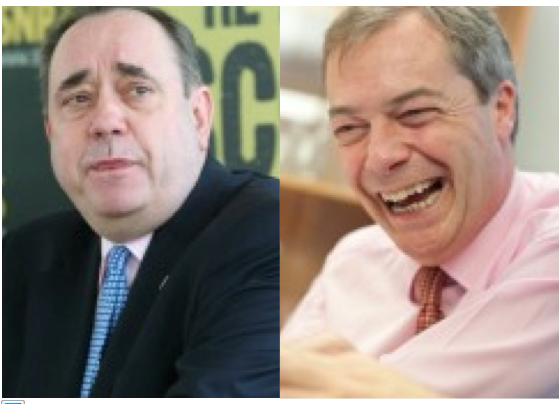
Alex Salmond and Nigel Farage were political twins
You will not find many references to Nigel Farage in Alex Salmond’s political obituaries. He and the leader of the United Kingdom Independence party are hardly bosom buddies. Salmond thinks Farage a backward-looking ‘little Englander’. Farage thinks Salmond fuels anti-English nationalism which abuses opponents.
Yet, as Salmond departs the political scene, it is worth reflecting on the similarities which lurk beneath the surface of the careers of the leaders of Scottish and English nationalism. Take their beginnings. In youth, both were inspired by causes at the fringes of politics. Salmond joined the Scottish National party as a student. In his autobiography, Farage recounts how he joined the Conservative party after a visit to Dulwich College by proto-Thatcherite Keith Joseph.
To support these fringe political passions, both earned their crust in financial firms now known best for their scandals – Salmond as an oil and gas economist for RBS, Farage at Drexel Burnham Lambert and Crédit Lyonnais.
But it was a cause in apparent eclipse that that drove them on. Salmond was on the radical left of an SNP divided and in retreat, even being expelled in 1982, for his support for a ‘Scottish Socialist republic’. The ‘extremists’ eventually displaced the mainstream, and Salmond secured the leadership with the princely total of 486 votes.
Farage was an activist on the hard Tory right during his City years, but abandoned the Tories in 1992 over Maastricht, spending years in the bewildering world of United Kingdom Independence party internal politics, where coup and counter-coup vied for control of the tiny party. In these small pools, their shared talents – oratory, charisma, a distinctive, media-friendly political voice, and the commitment of the workaholic – made them indispensable.
Neither’s rise to leadership was meteoric, but became a gradual inevitability. Perhaps as a result of the internal struggles that created their dominance, both men have been accused of treating their party as their personal plaything. Unusually, though, that indispensability has been proven. Both have ceded leadership of their party, only to return after their successors had clearly failed and they were called back to the colours.
One reason for their success is a certain sinuousness. Salmond has morphed from socialist republican to a royalist calling for lower corporation tax, advocating a Scottish ‘Celtic lion’ modelled on Ireland’s ‘tiger’, before a re-rejection of neoliberalism, an economic reappraisal that saw Salmond shift his attitude on sterling from ‘Millstone’ to ‘shared asset’, earning the approval of Rupert Murdoch. Also admired by Murdoch, Farage too finds it easier than most politicians to discard inconvenient commitments. From high-speed rail to flat taxes, Ukip policies are adopted and discarded with dizzying haste.
This willingness to shift positions might reflect their mutual fondness for a calculated gamble. Salmond is a former racing tipster, and Farage told Spreadbetting magazine he ‘frequently and often’ bet the family fortune on commodities trades. Both men enjoyed mixed results.
There is more than just gambling and tactical nous at play here, however. Their shifts are in the service of a bigger cause – independence, and a conjoined loathing of those, whether distant European bureaucrats or out-of-touch ‘Westminster elites’, who would deny a nation their voice. Each provides the consistency mere policies lack.
The enemy can be – and is – blamed for every ill, held responsible for all failings. Their eventual destination of freedom is worth every contradiction on the route. It is that insight that has made each man a successful, if mercurial, leader. But the cynicism it betrays may also be their greatest weakness – which, in Salmond’s case, proved ultimately a fatal one.
———————————
Hopi Sen is a contributing editor to Progress
———————————
Photos: Ewan McIntosh and European Parliament
On my temperature gauge MERCURY IS POSITIVELY RISING especially for Alex. Lol
Both these cynical gamblers can swing a few votes from UK electorate? Tremble-tremble.
Charisma is in the eye of the beholder. What would the Salmond’ SNP or Farage’s kippers do if those 2 jumped the party ship and left? They would be like fried Fish with no chips, or fish out of water: without these two ‘mainstays’ those two parties are as nothing – bubble burst, hot air gone.
Salmond had gone away – now he has regurgitated saying he wants a re-run of the Scottish referendum? [Who pays this time?] or he may run for a seat at Wetminster? His SNP backers must have a shedload of dosh to sponsor his latest gambles. Dog Track? Whatever he, Salmond, does on the political front is his decision in this a free United Kingdom. He knows that SNP’s new leader won’t attract anywhere near the amount of support and votes he garnered in Scot Referendum [with all due respect the lady has not got his particular line of Salesmanship. Some might call it being a good orator I say he has gift-of- the-Gab. And bulls**t Baffles Brains.
As for Farage – not to get personal – but I wouldn’t buy a 2nd hand car from him.
Both are destined for political oblivion – trouble is, they don’t see the writing on the toilet walls.
At the end of the day, its the VOTES FOR LABOUR that [count]. Any perceived similarities between these two egoists is their conjoined love of Gambling with other People’s futures, property and money. Miliband’s sober and well-thought out Plans for a UNITED United Kingdom will bring-home-the-Bacon – well alright, the ‘goods’, next GE 7th May 2015.
PS wee Eck and Nige’ – I bet you both a tenner each that Ed & Labour swoops in with a majority next May – let my bookie know?
In passing, to anyone still in any doubt: there is ONLY ONE MILIBAND in UK political machine currently, and his name is ED’ not David. After Hon E.Miliband MP’s heroic and brave speech in London yesterday I am now more than convinced that this man shall be as a breath of fresh air to UK politics. The Capt Bird’s Eye Haddock, Kippers and Salmon will be eaten for breakfast – remember to spit any bones out, or choke [!].
This article by Hopi Sen unwittingly articulates why Salmond and Farage are such successful politicians.
Westminster politicians and Westminster followers don’t understand them. And because they don’t understand them they don’t know how to deal with them. So the usual analysis (of Salmond and Fargage) goes something like the above i.e. Salmond likes to go to the races, Farage used to work in the stock market therefore the conclusion is, both are political ‘gamblers’. Hopi Sens’s stage 2 when writing this piece; trawl through the last 30 to 40 years and you find both men worked in the private sector. But rather than see the obvious positive this experience might bring Hopi Sen concludes that it confirms the untrustworthiness of both men.
Any proper objective comparison of both men would identify one glaring similarity that sticks out like a sore thumb and should be the beginning middle and end of any analysis of their politics. That is both men want to remove a tier of government from the UK. They have a vision. One vision (different tier, same vision). They both think we are unnecessarily over governed and want to streamline the UK political structure). This line of argument should be listened to, considered and maybe challenged if flaws in the argument are identified, but instead and because it throws up some unfortunate consequences for Westminster parties, especially Labour (EVEL), it appears that rather than face these realities a political blind eye is focused on the issue. As for example this article.
I cant speak for Farage and UKIP but I have followed politics in Scotland for 50 years and trust me, and I do not attempt to score a political point here, Scottish politics has changed over the last couple of years. The referendum has changed the psyche of the Scottish people. The No vote won the referendum but the Scottish electorate has become radicalised through it. The Scottish political landscape is no longer about right and left, Labour and the SNP, business and trade unions. It is about power. It is about Edinburgh and London.
Westminster and especially Labour Westminster don’t understand this revolution of ideas. This article is an example of the old superficial and lazy Westminster mind set; denigrating and maligning new political ideas at variance with the old order.
Labour was on the referendum winning side but at what cost. They made a pact (with the devil) and published it days before the referendum. No thought was given to the consequences. ‘The Vow’ is undeliverable (without leading ultimately to Salmond’s vision). For Westminster to renege or dilute the promise made in ‘The Vow’ will see Labour routed in Scotland next May.