
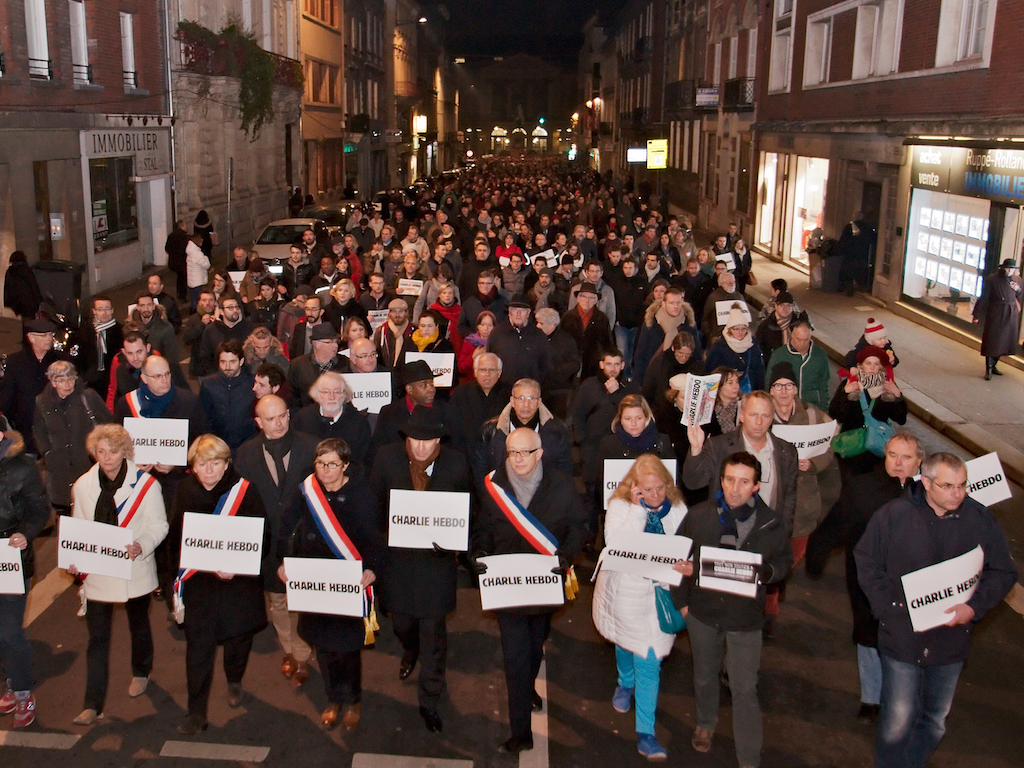
Events in Paris have been shocking and tragic. However, for those involved with protecting us from terror, they were far from unexpected. The continuing Islamist terror threat is real and known. In the United Kingdom there have been 140 individuals convicted of terror-related offences since 2010 and many other plots will undoubtedly have been foiled.
Among the dead in the Charlie Hebdo offices was the police officer assigned to protect the editor. He, and two other officers gunned down on Paris streets, gave their lives to protect the freedom of speech which has been much debated this week.
I am not a fan of the politics or cartoons of Charlie Hebdo. By instinct I would want to treat any strongly held religious belief with respect. But, without resorting to Voltaire, the fact that I would avoid it and others are offended is not a reason for censorship. Ironically the action of these terrorists have given the cartoons far more salience and publicity.
And, as quickly emerged, it is not just attacking freedom of speech which drives this terror threat. Even in France the attacks soon moved on from being about the cartoons to targeting those shopping in a kosher supermarket. Remember, other similarly inspired terror attacks in recent months have focused on those going to school, guarding a statue, shopping in an Australian mall or just being a girl. This is not a threat driven by specific grievances – or even UK-US foreign and defence policy – but rather by a violent Islamist ideology playing out across the world.
This is why Hazel Blears who played a key role in this work in government was right to focus on the long-term work to prevent radicalisation last week. And, as I argued here in June, this government needs to get beyond personal disagreements to reinvigorate efforts in this area.
However, the recent attacks also raise questions about our short-term capabilities to respond to the threat. Coincidentally, Andrew Parker, director-general of MI5, made his annual public speech last week, outlining the nature of the threat we face and the considerable success of his agency and others alongside the police and the public in tackling specific plots. It is sometimes easy to take our capabilities and resources for granted. During the hunt for the terrorists after they had attacked the Charlie Hebdo office, I reflected with Iain Dale on his LBC show about whether it would have taken as long to track them in the UK. It is impossible to be certain, but I think our CCTV and automated number plate recognition technology – so despised by the Liberal Democrats – would make it pretty difficult for a car to leave a major city and drive as far as the Parisian terrorists did without being discovered.
But in other areas we must avoid complacency about the technology that keeps us safe. Parker once again raised concerns about the way that new forms of communication technology are degrading the ability of the security agencies to be able to intercept and track terror suspects.
The criticism of raising this issue is that it is a kneejerk reaction to the events of last week. This is just plain wrong – the issue has been bubbling for several years. As home secretary I genuinely struggled to come up with an approach which maintained the capability which we have come to expect from our agencies in a way which limited potential intrusion on privacy and which could command public confidence. I understand those concerns but I never doubted that this is a job that needs doing. It is precisely our liberal democracy and democratic oversight which is anathema to many of those who seek to harm us. It is the role of MI5 to protect that way of life and those rights. In my experience this is what drives them as an organisation and as individuals. They are looking for capability to continue protecting our rights and freedoms, not to undermine them.
While we made some progress, we did not crack it. The fact that this government has similarly failed does not give me any satisfaction except to reassure me that this is one of the knottiest issues in national security policy and one which will be on the agenda of an incoming government after 2015.
———————————
Jacqui Smith is a former home secretary, writes the Monday Politics column for Progress, and tweets @smithjj62
———————————
M C.Hebdo RIP,Voltaire,FOI,Islam,Women-Only meetings, CCTV coverage, Labour Landslides Win in May, Leadership @ Labour, UK Security, USA Cyber attacks, today’s Opinion Polls variances and/or accuracy, etc., are all subjects which I, and many ‘000s other [blog-vocal] Pro-Labour supporters would like to discuss, but not via the pages of a very public site like eg, Progress mag, which is read by all and sundry from all walks of life – – its Internatonal.
We can’t let all our ‘good’ ideas be ‘nicked’ by opposition pundits or Ozzie advisers.
But I would like to ask, tongue-in-cheek and no offence meant whatsover to any female readers here, what the reaction would be from the ‘fairer sex’ [sic] should Ed stipulate that any meeting [and I stress ‘any meeting’] should be a ‘men only affair’ as is mentioned in another article/piece in today’s Progress which is pre-advising details of an upcoming event which is “Women Only”.
How equal is equal?
Forgive my ignorance but I had to ask what can be so private that men are asked not to attend.
If this is the case then the Rule-Book may as well be thrown out the door.
cf St Andrews Old and Ancien Golf Club, Masonic Lodge Rules etc.
A shiver runs down my spine for some reason.
Help and explain needed. [Maybe I am just thick].