
Debate about public service reform departs from the wrong starting point, says Hilary Cottam
The key lesson,’ begins Hilary Cottam, ‘is that everything – the thinking, the action, the design – needs to start from the point of view of people, not the institutions and how to reform them.’ She pauses briefly. ‘That sounds so basic, but it never happens.’
Cottam is founder and chief executive of Participle, an eight-year-old organisation which designs and helps to launch projects to demonstrate what the next generation of public services should look like. While it is probably best known for its Circle programme – membership-based services open to those over 50 which specialise in social activities, learning and health and wellbeing – Participle’s work has ranged across youth services, ‘troubled families’, and unemployment. Its approach – which focuses on motivating ‘deep participation’ and encouraging social connections and contributions – is both radical and challenges the assumptions and beliefs of many more traditional public service reformers. Thanks, however, to championing by the likes of Jon Cruddas, Tessa Jowell and Maurice Glasman, this relational approach to welfare and public services has begun to find expression in Labour’s thinking.
Participle’s chief executive is, however, critical of the manner in which the future of public services is currently discussed. ‘There is a fundamental challenge with the way that the public service debate is positioned in Britain today,’ she argues, ‘in that it focuses almost exclusively on the fiscal challenge and financial reform, on the one hand, and reforming institutions, on the other hand.’ This, Cottam suggests, is ‘the wrong starting point because the world has changed so significantly’. Instead of attempting to restructure existing institutions, she advocates ‘starting with [the] problem we’re trying to fix and then thinking what kind of other systems we need to design’.
But Cottam believes that too great a focus on the financial also misses the fact that many of the challenges Britain faces are ‘cultural rather than financial’. ‘They’re such bigger questions than resource,’ she continues, ‘so actually you’re missing half the picture with this narrow fiscal focus … and half the opportunity.’ Those cultural issues – social isolation and ‘a general crisis in relationships’ – may rarely feature on the domestic policy agenda but they underlie some of the biggest political challenges, such as how to tackle inequality. ‘There are new social expectations which are very different,’ she suggests. She cites the fact that people now need a mobile phone to get a job interview. Moreover, she argues, ‘you need social soft skills that people don’t talk about but still reinforce certain systems in terms of who gets into networks and who doesn’t.’
Participle’s approach is inspired by Amartya Sen’s notion of ‘capabilities’, a focus on helping people develop a set of core capabilities that will allow everyone to lead flourishing lives and be fully able to contribute to, and participate in, society. It is, Cottam admits, a conception of public services which is not necessarily easy to build. ‘You have to grow it, you can’t make it, you can’t give it, you can’t command it. That is really challenging for modern politics.’
‘We need to start with [the] problem we’re trying to fix and then think what kind of other systems we need to design’
In practical terms that means the organisation starts its work by ‘basically spending time embedded in people’s lives,’ explains Cottam. Whether working with families in Swindon or older people in Southwark, ‘our work starts [by] having Sunday lunch and playing bingo … really looking at the grain of people’s lives’.
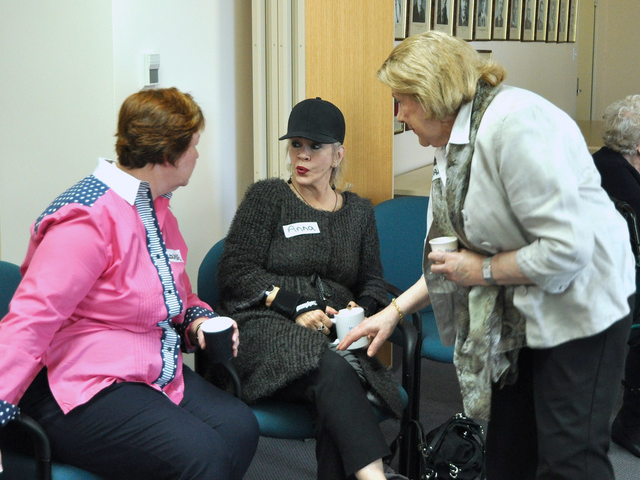
The Circle project was designed by talking to 200 older people in south London. They told Cottam and her team that, ‘they wanted somebody to take care of practical small things, and they wanted a rich social life by which they didn’t mean a paternalistic befriending, they meant making friends and interacting in a way that we all do through our lives.’
The effects of Circle have been practical and measurable. Tapping the support of both volunteers and paid helpers, the project’s ‘virtual home ward’ scheme, for instance, helps prepare people’s homes in readiness for their hospital discharge or treatment at home. Practical assistance such as mounting a key safe, moving a bedroom downstairs, keeping people company or setting up technology in the home have been proven to help bring down hospital admissions and speed up discharges.
But, Cottam notes, Circle can also point to rather less quantifiable, but perhaps more important, outcomes. ‘As those communities have strengthened, the communities have replaced [the] role’ which Circle was playing. ‘By building those communities and by strengthening those social bonds, other things start to happen.’
Although very different, Participle’s work with troubled families in Swindon has shown similarly positive results. It began with a call for help from the town. ‘I was told: “Look, I’ve got families, generation after generation, they are sort of like the canaries in the coal mine of the welfare state. They’re not being served, will you come and see what you will do?”’ Living alongside 10 such families on one of Swindon’s most problematic estates, observing both their lives and the work of frontline public service workers – from housing officers to the police and social workers – who interacted with them, proved revealing. ‘Understanding really what it felt like on their sofas when public service worker after public service worker came in to call and deliver a message and leave,’ was vital, Cottam recalls. ‘Through that process we began to construct a different way of working with the families themselves. That evolved into a four-stage programme that operates today: of inviting families in, opening them to change, fostering the core set of capabilities and then supporting them to use those capabilities to come back into school or whatever.’
Once again, the needs and desires of public service users are key. ‘The most critical difference about the programme,’ Cottam argues, ‘is [that] it is actually led by families themselves and they determine what happens to them within the programme … Rather than bring existing services together round the family, which would be seen as the normal step forward, what we’ve done is allowed families to drive where they’re going.’ The impact went beyond the families Participle was working directly with. ‘Families began to refer themselves to the programme – families that had disappeared off the radar or families that had one mobile phone to evade social services and another to talk to their friends,’ Cottam says. Moreover, such families, ‘really need support and are at risk, they report themselves in and we discover who really is at risk and build high-trust relationships’. She considers the key to this was that the power over their lives and how to address their problems was placed back in the hands of the families.
The Swindon project, called Life, also proved highly revealing about the public service workers. ‘We did exactly the same sort of anthropological study alongside frontline service workers,’ Cottam explains. At its conclusion, Participle told the staff they were spending 80 per cent of their time servicing the system and only 20 per cent doing any actual work and made them an offer: ‘If you work with us we will construct a system around you whereby 80 per cent of your time is spent actually doing work and actually engaging with people.’ It was an offer that, both in Swindon and elsewhere in the country, Cottam believes public service workers were all too keen to take up: ‘We run interviews with existing frontline staff who want to join our team and, I kid you not, they queue round the block … There is a hunger on the frontline to actually do work … I mean, no one actually joins public services to fill out a form and sit in a meeting, do they?’
Participle’s approach, claims Cottam, saves its local authority partners money. Circle, for instance, cut costs in social and adult care budgets. Indeed, the organisation provides its partners with an annual statement detailing the savings. Her concern, however, is that few of them are then reinvested in developing such innovative approaches. There remains, she says, ‘too much money in old ways of doing things … but what hasn’t happened is there are no real mechanisms of transfer to get that capital into the new ways of doing things’.
Moreover, there is not enough focus when budgets are set on the ‘really long time horizons that this kind of work needs, because to make these shifts is very complicated’. There is, she claims, ‘no national imagination about how things could work better’ and is clearly frustrated that lack of resources means Participle is not able to work with the 20 or so local authorities which want to adopt Circle.
Politicians, moreover, may talk the rhetoric of reform but, believes Cottam, until they change the criteria on which success is measured and judged, too little will change. ‘If everybody and the institutions still get judged by the old system then, obviously, everybody’s going to [uphold] the old system.’
———————————-
Liz Kendall MP is shadow minister for care. Steve Reed MP is shadow minister for home affairs
———————————-
Download the full pamphlet, Let it go: Power to the People in Public Services, here
———————————
About:
- Hilary Cottam is founder & chief executive of Participle
- Participle seeks to develop new models for a 21st century welfare state
- One of its best-known projects, Circle, is a membership organisation open to anyone over the age of 50 with a mission to build and support the capabilities of its members to lead independent lives
- Amartya Sen’s notion of ‘capabilities’ is a central tenet of Participle’s approach
———————————