

The coalition government’s own domestic research paints a damming picture of the performance of apprenticeships in England since 2010. The hard facts confirm what many independent experts have been saying for some time, much of the hype around England’s apprenticeship system has been built on quicksand.
From the prime minister down, the public has been led to believe that alongside a ‘jobs miracle’, the government has also produced a record number of people in apprenticeship: 2 million – double the number achieved in the last parliament.
Yet several studies published by the Department for Business, Innovation and Skills recently suggests that this headline figure is about as reliable as one of Bernie Madoff’s financial schemes. Like all such pyramid structures, which can only be sustained for as long as investors believe what they are being told by those at the top. The investors, in the case of apprenticeships, are ordinary taxpayers who have until now been inclined to believe what ministers have been telling them about the performance of a programme that costs the country £1.4 billion last year.
But it turns out that over 90 per cent of existing training, in the case of the over 25s, has simply been rebadged as and apprenticeship. The Department for Business, Innovation and Skills survey found that 4 in 10 employers were unaware that they were even participating in any formal apprenticeship scheme. Moreover, despite actually increasing the budget by £400 million since 2010, the number of new entrants – particularly 16-24 year olds – has plummeted by 20 per cent since Labour left office in 2010. Meanwhile, the number of over-60s classified as apprentices has increased by over 600 per cent.
It looks like the once prestigious apprenticeship brand, carefully nurtured and supported by all previous governments in a bi-partisan manner, has been badly damaged by the dissembling techniques of the current administration, desperate to grab plaudits. Quality, it would appear, has been sacrificed on the altar of quantity.
The situation is not much improved when England’s apprenticeship performance is compared to other countries. Any person on the high street will tell you that we lag far behind the high skill, high value apprenticeships found in most of continental Europe. Germany has twice the number of firms offering apprenticeships compared to the UK. Strong employer led sector bodies rigorously enforce training quality and standards; and it is impossible for politicians to gerrymander the statistics.
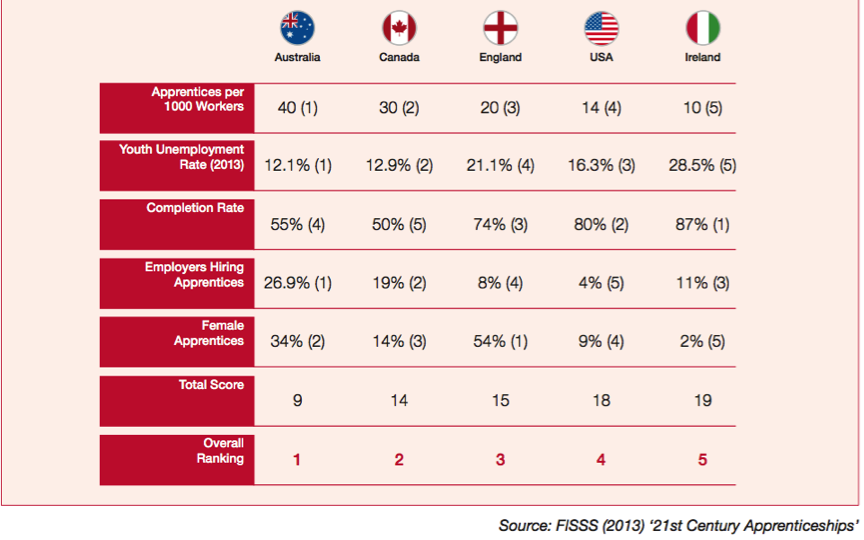
So how does England perform in relation to other similar countries, like those in the English speaking world such as Australia, Canada, Ireland and the United States?
Well, it turns out that we would struggle to pick up a bronze medal. Based on internationally comparable data, out of those five countries, England lies in third place for the number of apprentices per thousand workers and fourth place in terms of the number of firms engaged, see table. The one fillip is that more women undertake apprenticeships in England compared to other English speaking countries examined in the study.
The responsibility for regulating, reporting and safeguarding the apprenticeship brand should be taken away from the Department for Business, Innovation and Skills. The lesson from recent performance shows that ministers cannot be trusted to act solely as judge, jury and executer of something as important as a national apprenticeship scheme; the one policy intervention that could significantly boost productivity, and therefore, the prosperity of our nation.
———————————
Tom Bewick is CEO of the International Skills Standards Organisation and an expert on apprenticeships
But putting practically most government supported training into the apprentice system as been government policy from some years. It has now been rapped up into the reform of 16-18 where the skills are now defined by ‘industry’ (in fact adhoc panels) rather than by the skills councils.
There is nothing new about adult apprenticeships and the word has long since ceased to mean training for only young people. Prospect commentators should get an understanding of the system before they comment. However for the best Euro system they should look to Denmark