
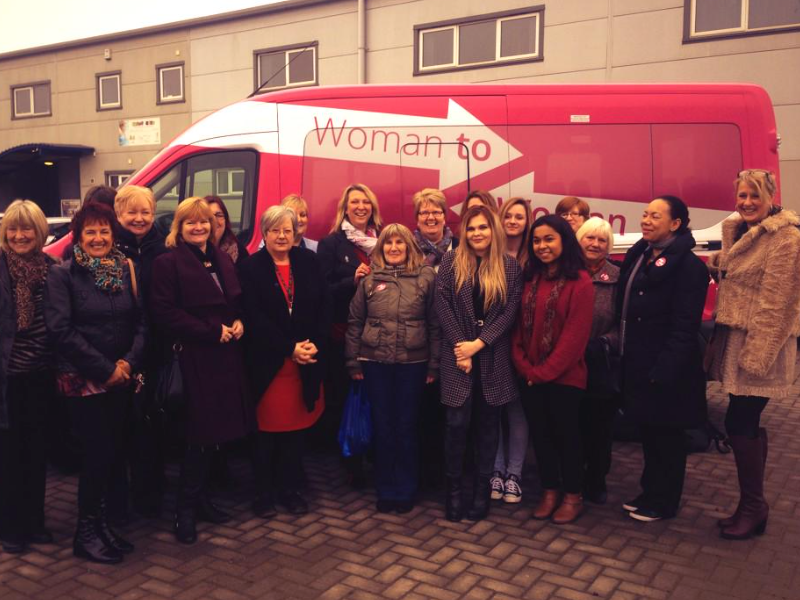
This week Labour launched ‘Woman to Woman’, a campaign that is dedicated to reaching out to women voters across the country, to make sure their voices are front and centre of this election. It is the first of its kind and, yes, we are loud and proud of it.
It is almost 100 years since women won the right to vote, but women today suffer from a different kind of disenfranchisement. 9.1 million women in the United Kingdom did not vote in 2010 and women are significantly less likely to say they are planning on voting than men. Is it any wonder when the politics they see on their television screens still looks like an all-male show?
As politicians we have a responsibility to change this, both the reality and the perception. This starts with getting more women’s voices in parliament, because a parliament that’s still 78 per cent male cannot be a true representative of Britain.
With more women members of parliament than all other parties combined and a shadow cabinet that’s 44 per cent female I am proud that Labour has led this agenda. And with almost all selections for the next election now complete we can see the result of our efforts. Over half our target seats and 65 per cent of seats where Labour members of parliament are retiring have women candidates meaning a Labour majority in May would see women representing 43 per cent of Labour MPs – at last within touching distance of 50 per cent.
Contrast this moment with the Conservatives and Liberal Democrats, who have managed to field women candidates in just a quarter and 31 per cent respectively of their target seats. The Green party or Scottish National party fare little better; and, perhaps unsurprisingly, the United Kingdom Independence party’s candidate list is a depressing 89 per cent male.
So the first aim of ‘Woman to Woman’ is to demonstrate to women across the country that Labour is a party where women’s voices are heard. And a Labour government will be one where women’s voices are equally represented around that top table.
This is a matter of basic fairness; it demonstrates to women, and men, that our commitment to equality is more than just words. But it also matters because women’s lives do differ to men’s. Women still shoulder the lion’s share of care, and women are still paid just 81p for every pound a man earns. To recognise this is not to patronise women, but to recognise the reality of women’s lives and say that we want a politics that speaks up for all perspectives. Just as a cabinet that is all-white, or dominated by people who went to just a handful of elite private schools will not represent the diversity of modern Britain.
In Stevenage on Wednesday, over 100 women came out in support of Labour’s candidate Sharon Taylor. All there to join the conversation, woman to women, about the issues they care about, from protecting our National Health Service to reforming our energy market.
At Asda we met store manager Sally and some of her team. None of them had ever met an MP before, but Woman to Woman is all about changing that. Fifty-year-old Lynne, who works full time on the shop floor wanted to tell us about how she regularly faces the choice between heating and eating.
Lynne’s colleague Louise told us she has two kids in primary school but it does not have a breakfast or afterschool club that would allow her to work the extra hours she needs.
At one point, I asked what words or phrases came to mind when they thought about politics, and one woman said: ‘stuffy old Westminster’. Politics is not delivering for these women.
But as the bus makes its way to every nation and region of Britain, to the 70 and counting constituencies its planning to visit, it is conversations like these that will demonstrate to women why a Labour government will deliver for them.
Whether it is our commitment to take action on equal pay by asking large employers to publish their pay gap, providing working families with 25 hours’ free childcare for their three and four year olds and guaranteed access to wrap-around childcare like breakfast and afterschool clubs when they reach primary school; boosting the minimum wage, banning exploitative zero-hour contracts and scrapping the bedroom tax which all hot women hardest. Our signature policies are ones that recognise the pressures so many women disproportionately face.
But this is a two-way conversation. Everywhere the campaign stops we will be asking women to tell us what they want a future government to do and what they do not want them to do too. In May this year I want us to enter government with the voices of the women we meet across the country ringing in our ears. It is only this way that we will be a government for the whole of Britain.
———————————
Gloria De Piero MP is shadow minister for women and equalities. She tweets @GloriaDePieroMP
Actually what the women we talk to want is for care-giving to be recognised rather than encouraging women to replace unpaid care work with paid care which they don’t all want. Socio-economic systems (and the language of policy) can value and reward invisible care-giving in all sorts of ways – for example by having a more family friendly taxation system, or through protection for child benefit, or schemes like citizen’s income. Also some countries offer home -care allowances. Talking respectfully about the importance of caregiving and about the contribution of caregivers would also be welcome since giving or receiving care is part of the human condition. We don’t want our primary school children to do long days away from home – we believe that the school day is long enough. We don’t want young babies to have to go into baby rooms and childcare settings , at least not for long hours, and preferably not unless all other avenues are explored to try and avoid separation between mother and baby or father and baby. Yes we agree we need better hourly rates of pay for everyone, including our young people. But we also need affordable housing and more social housing to protect the welfare net. Yes we agree to scrapping the bedroom tax. The trouble with Labour (and others) is that they only want to hear the voices of some women – not all. Many women value the time they are able to give to caregiving. We think caring for family is important and the only thing which makes us feel less equal is the attitude of policymakers who devalue care.
1. Has nothing to do with hearing voices you’re just after votes to get you in office. 2. If it mattered you would have voted for the champaign socialist to be the great leader
As a stay-at-home mum I would love to see my interests represented by any of the main parties. My husband and I have made considerable sacrifices to our quality of living in order to provide our children with what we see as the best start in life – the security and comfort of having mummy at home. My children are now four and six, and confident, secure, and already well educated. We expect to raise useful, reliable members of society. In return the government taxes us harder than families where both parents work. It would be good to have a tax system that took the family as a unit (rather than treating it as having two incomes) and also recognised the number of dependents within a household.
I would like my position as a full-time-mother to be respected. I intend to raise my children to believe that relationships are what give their lives meaning and value, not a pay-packet, and it would be nice to find a political representative who valued family over the economy. If mothers of small children need to work (given the tax burden levied against families it is hardly surprising when they do), it would be nice to see the government supporting a wider range of child-care choices. It has been demonstrated by numerous social and psychological studies that nursery is far from an ideal environment for under-threes – a child minder or an au pair for example, offer a small child the intimacy and consistency of care that they need for healthy development. We forget that as well as physical and educational care, a child’s emotional development is just as important. I would love to see politicians taking up the needs of the voiceless in our society (children) and representing these in parliament.
Every time that Labour or any other politicians talk about family friendly policy they only ever focus on childcare. What about families that want to have a parent at home to raise their children. It is also childcare but families with a stay at home parent are completely overlooked by politicians & erased from debates about childcare. We are unfairly discriminated against in the tax & benefit system & patronised & ignored by politicians. I would like to see families like mine recognised & supported.
The Feminist movement was about giving women choice and freedom; forcing women to leave small children to return to the workplace simply to make ends meet and facilititating it with wraparound childcare is not progress.
I dare you to ask your constituents – would you like us to enable you as a family to have one parent at home raising your children?
And
I dare you to consider your policies with Article 3 (1) of the UN Convention on the Rights of the Child in front of you, and answer honestly whether the drive to push ever younger children in to longer and longer hours of childcare is truly in the best interests of the child.
Labour, like all the parties, is driving down a one way street called Childcare with no regard to the value of care provided by parents themselves. Until you ask why are extra hours desperately needed to be worked (to pay for housing, food bills and school shoes) you ignore the real reason many women (and their families) need help with childcare. Support families to choose their own ‘best’ option. Look to America which has several ways of recognising households within tax and let families decide. Until mothers and fathers providing love and care ‘at home’ are recognised and supported, Labour does not have my vote.
Does Angela Merkel have a pink bus? Does Ellen Johnson-Sirleaf? Does Cristina Fernández de Kirchner? Does Dilma Rousseff? Still, I’ll drink a drink a drink to Hattie the Pink the Pink the Pink, the saviour of our human race -https://www.youtube.com/watch?v=2x8D4T–0v4.
If Private Eye had made this up, then they would have been vilified, not least on here, as public school misogynists. She ought to know better, but she has been set up. The Labour Deputy Leadership Election is on. While the Pink Ladies are on tour (singing Grease as they go?), who will be representing their constituents in the House of Commons?
In her day, Harriet Harman was a smooth operator. She has been in Parliament since before Tony Blair and Gordon Brown ever arrived, she has repeatedly come back from sackings and what have you, she was the guiding influence behind significant pieces of legislation in the Blair years, and she successfully gamed the Labour Electoral College in 2007 so that she became Deputy Leader the day after reputable polling had predicted that she was going to come last.
But even that was a while ago now, and Brown never showed the slightest sign of making her Deputy Prime Minister, dispensing with the position rather than giving it to Harman. Interviewed recently on Woman’s Hour, it was abundantly apparent that she had become a creature out of time, saying “childcare” over and over again while repeatedly unable to answer the point that childcare was now of great interest to many millions of men but of no interest to many millions of women.
She seems not even to realise that pink is now highly controversial within feminism. And of course the belated adoption of her 1970s version of it, the hatred of which for the Labour Party of the same decade was matched only by the reciprocation by the few Labour members who were of aware of its existence, was an integral part of the transformation of Labour into an anti-worker and pro-war party. After all, in those terms, who were the workers? Overwhelmingly, who fought, and who fights, the wars? The one in Afghanistan, in particular, was sold in heavily feminist terms, terms in which it has been an unmitigated disaster, just as it has been in so very many others.
But that is the past. Labour is nowhere near either as anti-worker or as pro-war as it was 10 or 15 years ago, whoever low that may be setting the bar. Moreover, as at least a relatively pro-worker and anti-war party, it is far more likely than not to win an overall majority this year, while its Leader is guaranteed to become Prime Minister. In the midst of all of this, Harriet Harman and everything that she represents are simply an irrelevance. Even the London Jewish atheist Ed Miliband regards a deal with the political wing of Ulster Free Presbyterianism as more important than anything aboard the pink battle bus.
For the second time, Harman will not be made Deputy Prime Minister. Therefore, this time next year, someone else entirely will be Deputy Leader of the Labour Party. This Parliament has demonstrated that there is no shortage of more than credible candidates.
child care,child care.that’s because many of the women mp’s have young children,or want to have more.what about the women carers,paid £61.35 for a 35 hour week.they don’t get the minimum wage.this pink bus.if the tories had done a blue bus.harman,and her cuties would have condemned it.sitting around a table,talking complete and utter rubbish .why do we have a shadow minister for women,and equalities in the first place?
all it’s about is keeping these middle class women in their very lucrative jobs as MP’s.
the people are fed up with this very long campaign.the display at PMQ’s was a disgrace.unparliamentary language.it’s supposed to be the Mother of All Parliaments.watching a Labour woman sat on the front row.pointing and shouting at the tories.was childish,playground politics at it’s worse.’hard working families’ ‘knocking on doors’.these two statements are starting to really annoy many people.sorry girls you are in the same westminster bubble as the men.it’s all about working women.zero about women who stay at home to look after the children or look after disabled children or their elderly relatives.
Has it occurred to the labour party that there are millions of mothers who wish to be able to raise their children, care for their children and nurture their children and families – and wish to be supported as mothers to do so?
Raising children – necessarily vulnerable and dependent people – is a crucial activity for the good of society at large. This needs to be recognised and valued.
Might the labour party stop to think that many mothers who are at home or wish – desperately – to be able to be at home raising their children are IN FACT DISENFRANCHISED by the very fact that no political party represents them IN THEIR CAPACITY AS MOTHERS at all.
You might seek to speak for mothers who work in paid employment. But this is not the same – you are failing to represent mothers who wish to mother. Who wish to be at home with their children. Harriet Harman you may denigrate us and sneer at us all you like: and you will have your answer as to why 9 million women did not engage in the political process at the last general election. We are disenfranchised. We are ignored. We are not valued. We are deemed regressive.
I have a long history of voting for labour. I have a pedigree in being raised by a trade union militant family. I am abjectly not a Conservaitve/traditional familty values esqu housewife. What i am is a woman who thrives on caring for her family – who thrive on the care I provide. Society will reap the rewards of my attentive raising of good, decent, articulate and caring individuals. I will put it into language any labour activist will understand: YOU ARE FREELOADING on the unpaid, undervalued and derided work of MOTHERS. I am an educated woman raised in a working class family who benefited from a stay at home mother. I want nothing more than to give my children the love and care I was given by my mother. You might not wish to believe it, but mothers matter. Not as workers. Not as slaves to the wage. But as mothers.
Until the politcal process and parties understand that the agenda pursued by the occupational elite, by women who wish to “have what men have” at the expense of women who wish to have “what mothers should have”, you will not get the vote of millions of women.
I could go on. But I just kNOW you are not going to listen.
Would Louise need those extra hours if she were paid a living wage? Why does Labour not just offer her the money it would eagerly spend on wraparound substitute care? Why discriminate? Does Labour not trust that the vast majority of parents are good enough to guide and care for their own children? Does Labour really think most parents would choose institutionalised childcare if they had other viable options? This is like offering golden crutches to someone who’s been hit by the Woman to Woman van.
Your leading women seem to be gatekeeping according to their own preferences. It’s not just about getting more women MPs into Parliament. It’s also – in fact mostly – about getting the rest of our (women’s) voices represented there. Crucial to remember.
Stop marginalising women who wish to provide our own good quality childcare.
Subsidise home-based care as well as substitute care.
Address the appalling discrimination in the tax system that sees single-earner families paying significantly more tax on the exact same income as a family with two earners.
Ensure benefits sanctions are not used to punish those with caring responsibilities.
Acknowledge that time spent caring for our own children is work that contributes to the economy and the community.
Please.
A Netmums survey of 4000 mothers revealed :
Of mothers at home with their children full time, 7% wanted to work more hours.
Of mothers working part time, 5% wanted to work more hours.
Of mothers working full time 88% wanted to work FEWER hours.
So why are your ‘solutions’ focusing on the tiny minority of women who want more childcare? Women want family friendly policies which enable them to spend more time with their own children. We are telling you this over and over. You are still not listening. We do not want more childcare. We want more time with our children. Stop spending money on subsidising childcare and start spending it on families.
I don’t want free hours or wrap around child care! I certainly don’t want before and after school clubs!! I want to raise my own children, not farm them out to strangers and have my choice upheld and supported by the tax system in this country. To be valued for my care giving role not for how much tax I pay..
Me & my family are currently penalised under the current system. We want more family time together not less!
I’m not a fan of Labour’s priorities for women. But I’m glad they’re trying. I think it’s a shame that they’re not recognising the value of caring, unpaid work which primarily women do, instead focusing on making women more and more available for employers, undermining the needs of their families. I’ve written more about it here: http://ohwedo.blogspot.co.uk/2015/02/patronised-by-labour-what-women-want-is.html
As a full-time mum, I don’t see anything here that will help me – I choose not to undertake paid employment so that I can raise the children that I chose to have, but don’t say I don’t work – I work harder now than I ever did in paid employment. I fully respect the right of all families to choose the right balance of paid work and childcare for themselves – so if other mothers and fathers choose to undertake full-time employment for both and pay someone else to raise their children, that’s fine, but I would like the tax and benefits system to recognise that the choices I (and many parents like me) have made are equally valid.
And one last point – a pink van??? If it’s for women it needs to be pink, right? Is that the most “female-friendly” thing you could think of? This just feeds the divide. How about policies that work for everyone, equally?
I want to raise my children myself, and so do many women I know, but they feel either pushed into work by unfair taxation policies or marginalised for choosing not to do paid work. Real caring – done for and by people who care emotionally about each other – is vastly underrated and demeaned, whether mothers and their children, adult children caring for parents, wives and husbands caring for one another when they get older – it’s a serious mistake by all political parties to ignore this important aspect of human beings. I don’t want my children pushed into a serious of before and after school clubs, or my elderly, and increasingly frail, mother being shunted into a care home – I want to be able to care for both ends of my family without being to made to feel non-productive – I AM producing decent human beings who will be next generation’s parents (my children), and I AM returning to my mother the care she gave me as a child (she was a highly-qualified woman who gave it up to raise her children) – none of this is of remote interest to the number crunchers of government.
Women who don’t vote aren’t scared off by ‘stuffy old Westminster’, but by out-of-touch politicians who do not listen to the electorate; we are weary of being told that MPs are listening to women, that you are ‘in it’ with us, that you know what matters to us – it’s all lip service to entice us into the ballot box.
I think all political parties are guilty of divide and conquer tactics with their so-called family policies – pitting working-for-money mothers against those who choose to be unwaged, full time mothers. Both groups, and various permutations in-between, are valid family models for women in this country, but they are financially different, and some groups are discriminated against in our taxation and benefits system. Bills for council tax and water, parental responsibility for children, mortgage contracts and other legal and financial concepts are based on a household, or at least a couple’s, income and recognition of them as one unit rather than 2 separate ones. The tax system needs to catch up! If a woman in paid employment can receive government cash towards her paid childcare, why can’t another woman transfer her tax allowance to her husband or parter, to try to balance the books? Why is so much legislation geared towards women being in paid employment, and thus young children in paid-for childcare, rather than recognising a woman’s choice in these matters? It seems to me that only certain choices are seen as valid and worthwhile by many people, politicians included.