

The 21st century has so far brought an accelerated pace of change that too many communities in our country are ill-equipped to deal with. These changes – among them globalisation, longer working lives and longer life expectancies, with all that this means for public services and the redistribution of resources – are predictable. Our national failure has been in ensuring that everyone affected by phenomena such as these are prepared for the consequences of the changes. Labour, more than any other political party has always been the party best able to understand the changing world – modernity – and to respond accordingly. Born from the struggles of the industrial revolution, Labour can claim to have led the western world in developing progressive political thought. Social justice, racial equality, universal suffrage, feminism: Labour and its progressive forebears have always been in in the vanguard of developing and advocating these causes.
Pinkos
That’s why the party’s pink ‘Woman to Woman’ battlebus/multi-purpose attack van/Peppa-Pig Decepticon was in its own way so important. Titter ye not. Watching the 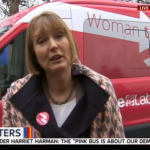 serial misogynists of the rightwing press queue up to denounce the bus (after begging to get on it) was a real through-the-looking-glass moment. Tory criticism was particularly strange (a habit they need to get out of) when they’d just taken a load of lucre from feminist icon Peter Stringfellow (can you check this, ed?) and and auctioned off a shoe-shopping trip with Theresa May. Say what you like about changing demographics and flexible political loyalties, you can always rely on lap-dance lovers and shoe fetishists to shill for the Tories.
Those peering through the faux outrage will see that Labour is the only party to attempt to address the issues affecting women in this election campaign to date. We’ve done this for a century now …
Crisis of masculinity?
During one of the first bus outings, the inevitable conflagration with a male protester occurred. A self-proclaimed ‘victim of feminism’; I offer no insight into the motivations or experiences of the man in question only to say that such a claim is demonstrably absurd. That we still live in a male-dominated, country, culture and world is indisputable – but if we accept that this means that the status quo is one of unfettered success for British men then we are lying to ourselves. We should be unambiguous about this.
Scratch the surface of the upper-middle class patriarchy and there is a crisis of masculinity affecting modern Britain. This crisis is brought into sharp focus by a report from the Samaritans this week which shows that men aged between 35-54 from the most disadvantaged backgrounds are a greater suicide risk than any other demographic. Figures fro m the ONS show that 6,233 people over the age of 15 killed themselves in 2013, 252 more than in 2012, and that the male suicide rate is three times the female rate. The suicide rate among men is at its highest regional level in the north-east of England. Some commentators attribute the steep rise to social and economic factors, others to the changing role of the traditional male role in deindustrialised communities. I suspect both factors have contributed to this tragic statistic.
Analysis of the problem is fairly easy. Solutions, less so. Labour has an enviable tradition of advocating the feminist cause – and there is still so much work to be done in this regard. The party will always be the party of the working class (never to the exclusion of any other class) and the pursuit of social and economic justice is the very reason for our existence. But for thousands of men who see their economic usefulness and their gender as part of a single coherent identity, more must be done. This is as much about class as gender. Of course there is a greater need than ever before for outreach work, mental health workers, and other services, but this is about more than a problem requiring a service to be provided in order for a solution to be found. No, the voices of these men should be heard – without any disbenefit to the other social groups whose cause we carry. Their stories should be understood and their experiences recorded. If Labour doesn’t do this – if we are not in the vanguard of listening to these people – who will be?
‘Little people’ like us
American businesswoman Leona Helmsley, nicknamed the ‘Queen of Mean’ was convicted of income tax evasion and other crimes in 1989. Although having initially received a sentence of 16 years, Helmsley was required to serve only 19 months in prison and two months under house arrest. During the trial, a former housekeeper testified that she had heard Helmsley say: ‘We don’t pay taxes. Only the little people pay taxes.’
The longer the prime minister blocks an investigation into why HMRC allegedly took it easy on the HSBC bank when ordinary taxpayers and small businesses are pursued ruthlessly and aggressively, the more it might appear that this is a sentiment that both he and the strangely invisible George Osborne agree with wholeheartedly.
———————————-
Jamie Reed is member of parliament for Copeland. He writes The Last Word column on Progress and tweets @jreedmp
———————————-
Photos: Sky News; pagedooley; wikipedia