

On the face of it one might argue it is just different: a national list system. You vote for a party, and there are 120 seats in the Knesset, so the governing party needs to have a coalition of over 60 seats. At no time has one party got 60 votes, so there is always coalition. Until this election you could just get enough votes to get one seat; this time the quota is set at 3.25, so if you fall below that your party gets no seats and the votes go in the dustbin.
The elections in the United Kingdom are mainly fought around socio-economic issues. In Israel you also have to factor in security-peace, religious-secular and Ashkenazic (originating in Europe)-Sephardim (from North Africa/Middle East)-Russian (the more recent Russians). Add to this the 20 per cent of the electorate who are Israeli Arabs – while in the past there were a number of parties this time they have joined to make one list. The Arab parties have never joined the government coalition.
For each of these there are parties and factions within parties.
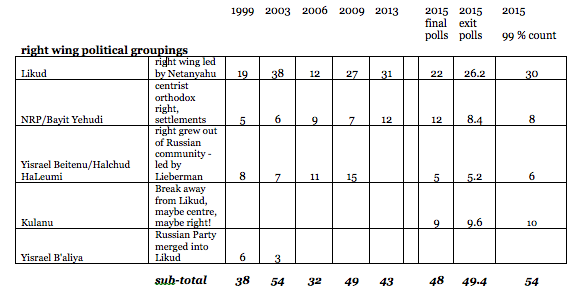
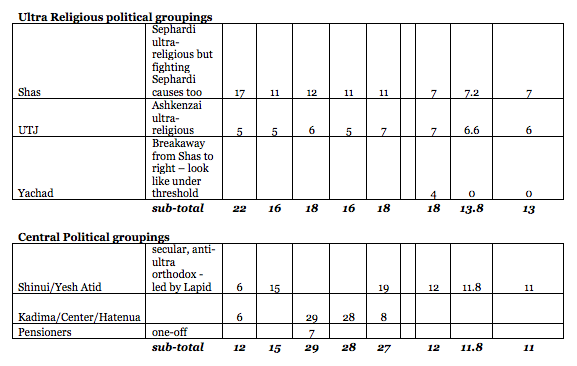
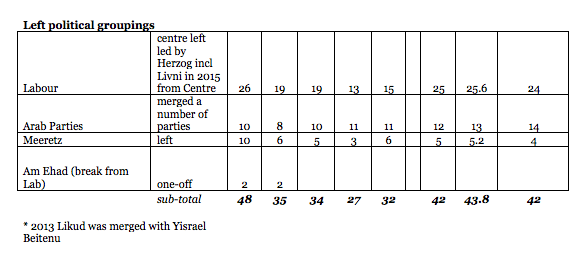
The last time there was a Labor coalition, the left bloc was stronger and had better relationships with the religious parties. No coalition could easily be put together with both the religious and yesh atid. Kulanu might have switched left had Zionist Union been stronger. However while a national government is possible, it has never been good for Zionist Union to play second fiddle if Bibi is prime minister. So a right-wing political in coalition with the right-wing religious parties, plus Kulanu, seems most likely outcome, unless there are some sudden shifts in the remainder of the count.
Isaac Herzog certainly improved Labor’s fortunes but not by enough! In some elections there would now be days, weeks or even months of wrangling while a coalition was put together this time it is not necessary as the centre and left are not strong enough and the right and ultra religious parties are desperate to be part of government. Yesh Atid, as secular and hence opposite to religious are not an option and Labor should not panic themselves into a national coalition.
So a very right-wing government with nothing to the left of Likud will lead to a politically divided Israel. The centre, centre left and left must now rebuild rather than blaming each other.
Kulanu could have been the centre right in a centre-left government but the centre and left are not strong enough. Kulanu’s leader would see little purpose even in discussion. He now has to not make the same mistakes as Yesh Atid leader, Lapid, in that he wants the finance minister job which normally does not lead to future popularity. Maybe he will succeed; probably he will fade back into Likud.
———————————————————
Andrew Gilbert is a trustee of the London Jewish Forum and member of Progress. He tweets @AndrewGilbert1
———————————————————
I don’t understand what the point of this article is. It is full of statistics and charts, but without a conclusion. Can anyone from Labour Friends of Israel help?
Is the re-election of B.Natanyahu good or bad for the future stability of the eastern Mediterranean, and the globe? Does.Labour support his re-election or regret it?
It is bad on all counts. Bad for any direction towards co-existence. Bad for those wanting 2 state. Bad for the non ultra religious. Bad for the balance of relationships with Europe, USA and anyone else. Likely to make it harder for international Jewish community to back Israeli govt actions on security. Likely to bring further regional meltdowns/wars. From a UK labour party perspective I hope that there will be opportunities to increase contact with the left parties of the Opposition including the arab joint list, as well as labour and meeretz