
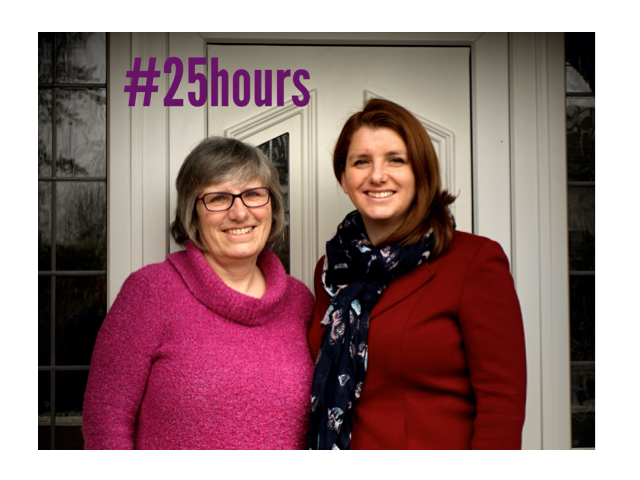
Twenty five places to talk about 25 hours. I have been all round the country – from Thurrock to Swindon, Hornsey to Morecambe. But for the 25th place, there was only one place I wanted to go: home.
For the past five years, I have represented Wirral South. It includes the hospital I was born in and the house I grew up in. And, much more importantly, my parents. My mum worked with small children throughout her career, and knows a huge amount about early years education. So for my 25th visit, here is my interview with her on starting a preschool, children, and why loving books is just like going home …
Alison: So why does early education matter for children and their families?
Ann: I was thinking recently about how going to preschool, for a child, is like learning to use a book when they are very small. It gives them all the skills they need to make the best of school when they get there. They learn to go in; they learn to sit down for the register; they learn to do things on their own; with one friend; with a group of friends; in a small group; in a big group; listen to adults. They learn there are certain rules when you are doing things, certain safety things. They learn to ask questions, they get used to being with adults, and up close to them.
Alison: So it’s about skills to make the most of their education?
Ann: Yes. And obviously, it’s also about them having a whole range of equipment. It’s still being child-centred, but they are given pathways that they might want to go along – their eyes might be opened to things they might want to discover.
Alison: It’s like a bridge between home and school?
Ann: Yes – exactly. You’re not going with your parents and you’re old enough now to start making your own way in the world – it’s your first footstep, if you like, on your own. I know that children go to childminders, but that’s like home-from-home, isn’t it? And even nursery, it’s not the same – there may be education there, but it’s not an educational setting.
Alison: And what motivated you, personally, to be involved in early education?
Ann: Well, it was because you and your sister had gone to a nursery class, because I was lucky enough that someone had told me about a school that had a nursery class, that if you put your name down you might well get a place and both of you did. But when it was your brother’s turn the rules had changed and he couldn’t get a place. So we just tried to fill the gap.
Alison: There wasn’t anything, so you did it yourself?
Ann: Yes, basically.
Alison: And what was it like to start a preschool?
Ann: There were lots of barriers and lots of people didn’t think we could do it, although we weren’t setting a precedent, it had been done by other people on the Wirral, so we went to talk to them. And I’d say that my friend Anne was the absolute leading force and I was the backer-upper and note-taker – she had the ideas and I had the practical side, saying what we could do about this, or ‘couldn’t we all gather some toys from each other’ and things like that. So together we made a good team and there were two others, but Anne and I did the initial footwork.
Alison: So you managed to just get toys …
Ann: Just from our own houses, really. There weren’t so many charity shops, so just from our own houses and I think initially we might have bought a couple of things, but obviously we started from nothing. No money, so it was just what we could do ourselves and provide ourselves.
Alison: Amazing. And what has changed, do you think, in early education, from when you started, twenty-five years ago, to now?
Ann: There’s more of it available. I mean, we weren’t inspected by Ofsted, but I’m pleased to say that the routine and everything seems to be the same.
Alison: So the basics are the same?
Ann: Yes – I think so. We did a lot of reading and had our own experience and knowledge and put together a package of what we thought was the best thing to do.
Alison: What kind of things did you read about?
Ann: What they did in other countries, what people thought was good practice, and it was about that time it was coming in, child-centred learning so we tried to hold to that and tried to find ways to encourage the children to do different things. Obviously not forcing them at all, but sometimes using quite a bit of persuasion to get them to make a Mothers’ Day card …!
Alison: So when you say child-centred learning, what does that mean?
Ann: It means that it comes from the child – things aren’t imposed on the child, the child leads the way, the child goes to what interests them. I think it was our job to try to make everything appealing to every child, which sometimes is harder than others.
Alison: And of all the experiences working with children that you’ve had over all of your career, what are your strongest memories?
Ann: That’s very hard, because there’s so many. One thing is that, on one particular day, perhaps a part of my life when I was perhaps as low as I’d ever been, that was when I was working in speech therapy, and it was just amazing how many children came up and gave me a hug. So obviously they are aware of things – I think they are a lot more switched on to how people are than we are perhaps. As I say, there are so many things, so many children … When I was doing my NVQ, one of the things I had to do was ask some parents for a little report on how their child had got on working with me and one was very nice and said afterwards that their child kept asking when they could go back to speech therapy!
Alison: Bless! And just one last question: I always remember you talking a lot about books and the importance of books. Why do books matter to very small children?
Ann: Because there’s so much from a book – not just a story. For a baby, mostly you’d have the baby on your knee, so they’ve got the comfort of being near an adult, with the adult’s arms around them, shared attention, which for a small baby you don’t really get that, because it’s not really until they are about ten months old, when they can sit up and they can point to something – but if you look at a book, and I’ve got a photograph of your sister and your nephew, and he’s sitting on my knee and she’s holding the book – I just think it’s the best photo because he’s looking intently at the book and we’re all together, doing it together. He’s much too young for us to say, ‘Oh, look at that’, but we’re still sharing the book. They can have books from a tiny baby, and they can chew them and bite them and feel them, and learn how a book works. It sounds so basic, but it’s so important. And they learn those black marks are so important to the adults and they hear the language, it becomes familiar to them. It’s like a lullaby or a nursery rhyme book that they know.
Alison: So getting used to books is like getting comfortable with the idea of reading very early on?
Ann: Yes, but much more than that. It’s the comfort of sitting by somebody, doing something together, that person’s giving you their attention. It’s the familiarity with the language, it’s hearing the language. When you go back to a book you love, for a small child or an adult, it’s a sort of going home.
———————————
Alison McGovern is shadow minister for children and families. She tweets @Alison_McGovern
———————————