
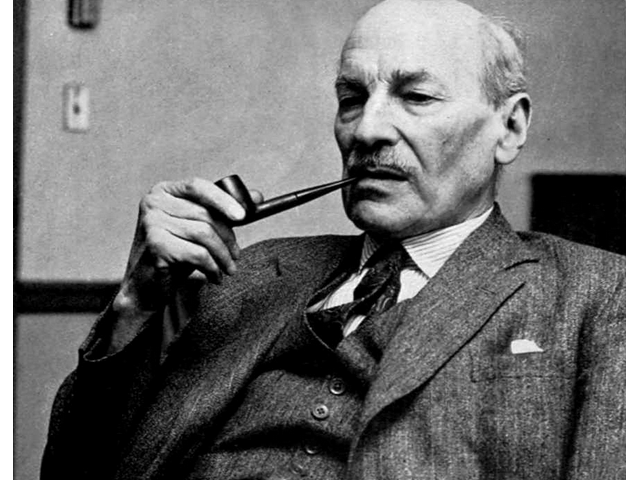
This year will mark the 80th anniversary of the Labour party leadership election of 1935. Its long-term historical significance is not in doubt, for its winning candidate went on to become the 20th century’s most successful prime minister, leading the great postwar Labour government of 1945 to 1951. At home, there were nationalisations of industry, the founding of the National Health Service and of the modern welfare state. Independence for vast swaths of the British empire were granted abroad and the general direction of British postwar foreign policy was set. Yet nobody would have predicted that this was what Clement Attlee would achieve when he was elected party leader on 26 November 1935.
George Lansbury’s leadership of the party had been effectively ended by Ernest Bevin at the party conference that year. Bevin had attacked Lansbury’s pacifism as being at odds with the general support of the party for the use of force by the League of Nations to deal with the Italian invasion of what was then called Abyssinia on 3 October 1935. Lansbury duly resigned the leadership when parliament returned on 8 October.
Events moved swiftly. On 23 October, the Conservative Stanley Baldwin, who had himself replaced Ramsay MacDonald as prime minister of the national government on 7 June, called a general election for 14 November. Attlee, who had been deputy leader since 1931, became caretaker leader during the election campaign with a view to a full contest being held after the results were known. In the general election itself, Labour increased its vote, and its number of parliamentary seats, from the 52 won in the disaster of 1931, to 154.
This gave Attlee the advantage of being an incumbent, albeit a temporary one. At this time, the Labour leadership was decided only by the votes of members of parliament. In his autobiography, Herbert Morrison recorded that Attlee took 58 on the first ballot, with Morrison himself taking 44, and the third candidate, Arthur Greenwood, 33. On the second ballot, ‘all but four of Greenwood’s supporters voted for Attlee’ – the final result was Attlee 88, Morrison 44.
There is not a great deal of direct evidence as to why Attlee won. Nonetheless, there is no shortage of explanations. Hugh Dalton, a supporter of Morrison, offers an explanation that Attlee had taken most of the votes of the 52 MPs who had served in the 1931-35 parliament. This has merit. After all, Attlee, Lansbury and Stafford Cripps had, together, carried out the functions of the leader of the opposition in this period. Attlee had impressed in the role. Dalton also suggested the involvement of Freemasons; Greenwood was the ‘Masons’ candidate,’ and, on 22 November, they had met to decide on strategy, which had the consequence of transferring the Greenwood votes en blocto Attlee once he was eliminated from the ballot. Dalton also suggests that the expectation that Attlee would only be a temporary leader was helpful. Some MPs who themselves had leadership ambitions may have thought electing Morrison would settle the leadership question in the long term, damaging their own future prospects. There is a further explanation that Morrison’s model for nationalised industries run by a board, based on the London Transport Board, was strongly disliked by union-sponsored MPs.
Weighing up the significance of each of these arguments is inherently difficult. Yet there can be little doubt about the achievements of the winning candidate. After the leadership ballot, Dalton lamented, ‘A wretched, disheartening result. And a little mouse shall lead them!’. Attlee turned out to be some mouse.
———————————
Nick Thomas-Symonds MP is the member of parliament for Torfaen and writes the Labour history column for Progress. He tweets @NickTorfaenMP
———————————