
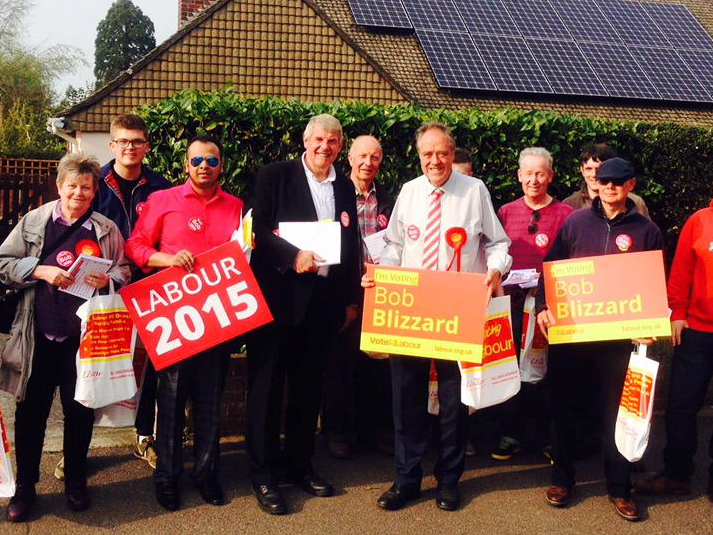
May 2015 was the fifth general election I fought as a candidate. I spoke to more voters in this campaign than all the others put together. I shook lots of hands in the ‘blitzing’ sessions of 1997, but that involved little more than ‘thanks for your support’ as the big Blair wave swept me and 417 other Labour candidates to victory. This time it was three and a half years of relentless doorknocking, and in Waveney we were always near the top of the league for the number of people we spoke to – well over 30,000 between January and May alone. I ran several successful community campaigns too. So my analysis of what went wrong is based on all this – not armchair punditry or a preconceived ideology about what Labour must now do to yet again ‘reconnect’ with the electorate.
I found virtually nobody who disagreed with the policies we put forward. However, many people did not really know what they were. For example, I met few who knew of our plan to help small businesses by cutting business rates and improving bank lending. Late in the campaign, undecided voters often said they thought all the parties had some policies they liked. I met nobody who liked the idea of fragmenting the National Health Service by handing out contracts to private companies.
The policy with the most traction was raising the minimum wage to £8 an hour. In social housing and lower income areas, where the response in 2010 was all too often a disappointing mix of indifference and hostility, there was a different mood this time and our policies to help with the cost of living seemed to produce a much greater readiness to vote than was evident several weeks before the election. On numerous occasions, a conversation about raising the minimum wage and ending zero hours contracts helped to turn voters – especially younger working-class voters – away from leaning to Ukip and towards Labour. I felt that people were once again talking to each other about voting Labour.
The Ukip factor was still there though, and I believe it would have been far greater had we not concentrated on working class voters with policies that would directly benefit them. We always carried a leaflet on Labour’s three main policies to control immigration, to respond to those who raised the issue. This too helped to counter the appeal of Ukip.
Those voters in modest owner-occupied areas, where we found our strongest support in 2010, seemed to still be with us and in greater numbers. Those who spoke about ‘the mess that Labour had made of the economy’ seemed to be people who didn’t vote for us in 2010 and had no intention of doing so this time. My bench mark throughout was – how does it feel compared to 2010? It nearly always seemed better, and until that exit poll, I was sure I would overturn the 769 Tory majority.
But, there was one comment that kept on recurring, not only from others, but from Labour identifiers too. Painful as it is to say, it was simply that many voters could not see Ed Miliband as prime minister. The brutal truth is that if people do not ‘get’ the messenger, they do not get the message. We worked so hard, so much harder than 2010, that I thought this alone would get us over the line to victory in Waveney. But in a media age, the way voters view the leader is paramount. All that doorstep work and community campaigning is undermined without the foundation of a leader who people see as convincing. Did we not fear that all along? We arrived at election day happy – or relieved – to be level pegging in the polls, while the Tories were disappointed at what those polls predicted. In the end, unsure voters thought that Cameron was better than Miliband, and better the devil you know.
Concerns about economic competence were built into this judgement. Failure to defend our economic record compounded the problem – and it is still going on. It took us 18 years to recover from the winter of discontent. We could be in danger of taking just as long to redress the myth that we caused the banking failure, the recession and ‘the economic mess’ the Tories inherited. But to get that message people have to believe the messenger.
In 1997, when we were surfing down the streets on that big Blair wave, it was not policies that created it. It was not those modest and cautious pledges on plastic cards that excited the voters. It was the new man they liked. A compelling personality that brushed off ‘bambi’ and ‘devil eyes’ media attacks, eyes that looked into the electorate’s and transmitted trust and freshness, and a command of thought and language that was prime ministerial. This gave us the landslide over a tired Tory party that the electorate had wanted to dump in 1992, but had been drawn back to through nervousness about Labour and its then leader.
So let’s not slag off the policies we were proclaiming just a few weeks ago. That makes us look really unprincipled. Can anyone name the Tory policy on aspiration that destroyed us? What was the missing policy which would have given us victory? Do those floating voters who may have decided the outcome on 7 May really think in terms of left and right? So let’s not fight each other in a false policy debate. It will probably be some years before it is sensible to set out our stall for whatever conditions might face the country in 2020. It is all very well to soul search about values and talk about a big picture, but increasingly sceptical and consumerist voters will ultimately want to know what we will actually do for them.
What the voters will take most notice of first is the quality of our new leader. Is he or she better, stronger, more appealing and genuine than George Osborne, Boris Johnson, Theresa May or David Cameron. That is the challenge whoever will be our next leader.
———————————
Bob Blizzard is former parliamentary candidate for Waveney
———————————
Never mind that, the big news is that Tories are cheering today as Jeremy Corbyn gets on the ballot!
Fantastic news!
– member of the Socialist Campaign Group
– weekly column in the Morning Star
– CND supporter
– ex-Haringey councillor
– pro-IRA
– climate change loony
– pro-Tamil Tigers
– pro-Palestinian
– pro-Argentine
Batshit, abject loony lefty. Like a breath of stale air from the 80s.
Yippee, 10 more years!
I do think that the reasons stearing us, we won three elections under New Labour. But the reason is we kepted all Thacher’s policies. I do think that the biggest mistake we have made is we never rebuted the last Colations Goverment which they kept on saying that we wrecked the economy and it became their mantra ane media play a big part in our demise also.
For a political party that uses diversity and multiculturalism to get elected Labour only put forward jumped up middle class party placements for their own top jobs.
And an anti Jewish pro IRA stain on humanity.
Much more sense than is generally talked on this site. However, there is no mention of the – I can’t be bothered to vote for any of you – response “you’re are all in it for yourselves”. A response from non-voters and some UKIP. Looking at Tristram Hunt – whose election turn out was less than 50% – I think it is clear that there are many we are not getting to who are natural Labour voters. We think they have nowhere to go as we seek to distance ourselves from the Welfare State – but in truth they can just stay at home. (The Welfare State is a creation as important as the NHS and must be defended as something we almost all rely on at some time.) Not challenging the Tory economic arguments was a massive issue. I can’t remember how many times I watched a Tory or LibDem say “Labour crashed the economy” and the Labour person being interviewed just moved on to something else. My MP claimed that they had tried to put the argument, but the media were not listening. Rubbish. The Tories put their argument in every interview for 5 years. I don’t think our answers on immigration could ever sway UKIP voters – what we should have been doing over the years was setting out the context. Free movement of workers is something that goes with the EU. No-one can claim benefits and housing as soon as they arrive here. Most migrants are young and hard-working and benefit the economy. I have also seen figures that suggest as many Brits live in Europe (mainly France and Spain) as Europeans live in Britain. But always we followed the line of apologising for our previous policy on immigration and saying we would be tougher (in some largely unspecified way). Did Cameron apologies when he didn’t bring immigration to below 100k, or only halved the deficit (two absolute and unequivocal pledges). Not a chance. Apologies high-light your failure, rather than the defence arguments you give. I think in 1997 any competent leader would have defeated the Tories. But the right talk as if it was only Blair’s lurch to the right that brought victory. We got more Labour votes in 2015 than Blair got in 2005 – it is just that the 3 way split had changed. Blair had no magic formula and implemented many of the Tory policies of privatisation (health, education and housing) that the Tories built on in 2010. At the end of 12 years of Labour Government – in a boom – working people ended with a smaller share of the nation’s wealth than at the beginning. We should have been able to remove Miliband – or he should have had the sense to go – well before the election. His performance in the last few weeks was adequate, but couldn’t make up for 4 years of poor leadership which did little to develop or agree any policy or strategy to fight the Tories. I agree, lets not slag off our own policies – as practically every leadership candidate has done. But it no good us again going 4 years saying to the public – don’t worry we will develop some policies before the elections (or rather the leadership will pull some out of the hat to surprise us all). We are a party of principle – Socialist, or at least Social Democratic. We have principles about fairness, about the rich paying more, about collective ownership and democratic control, about people all paying their fair taxes, about a safety net for those who are ill, disabled or just unemployed. Do we think free child care for the middle classes is a better use of money than reduced tuition fees for middle class students? How will we end zero hours contracts? How will we control rents and utility bills and the banks to ensure that that monopolies, multinationals and those who have much more power than consumers, will be regulated and prevented from an unreasonable level of exploitation? Let’s at least set out our vision – then we can fill in the gaps and the detail before the election. In my constituency we increased our majority, and we won in neighbouring Chester – eliminating the Tory majority of nearly 2000. We also won Cheshire West Council from the Tories, winning 6 seats. So yes, my views come from knocking on doors weekly for 18 months, daily for 5 weeks.
I agree with the common sense article from Bob Blizzard that the messenger is important. Is there a Denis Healy,Harold Wilson,Jim Callaghan,Shirley Williams or Barbara Castle out there?
No, but there is a Jeremy Corbyn, a Liz Kendall and a Butcher Burnham – political titans all.
An interesting piece from Bob Blizzard who was on the “front-line”. I worked for our Parliamentary candidate, Uma Kumaran in Harrow East, another of 1 of the 106 key target seats. All the evidence was there during the campaign that Labour were not going to win but, because I trusted the Polls I did not believe the “real” evidence”. I found four key factors worked against Labour in Harrow East, our Leader, a lack of trust on the economy, the fear of Labour having to dance to a SNP tune and that we did not offer an EU referendum.
Bob Blizzard suggests the choice of Leader is the key. Maybe. Whoever the new Leader is they have a much more difficult task than Neil Kinnock did after 1987. We need to win back SNP voters, ‘pink Tory voters, UKIP voters and Green voters. It has to be a Leader who can combine Labour values of support and compassion with a hard-headed approach on the economy that provides jobs and growth while drawing a clear line that some of the big business chicanery that went on unchecked under Blair and Brown is not acceptable.
Our Opposition also needs to be principled and effective. Too often during 2010-2015 we attacked the Tories on policies Labour had introduced. Atos, Academies, PFI. Our Opposition has to be more nuanced pointing out where the Tories are going wrong. The Benefit Cap is a case in point. Over 50% of UK voters voted for Parties who wanted to cut the cap. Therefore our position must be to again criticise it not in principle but that cutting the cap will do damage in London and the South East, etc.. It’s not just a photogenic Leader we need but a sensible set of policies that have continuity with 1997 – 2010 and expose the Tories for what they are, incompetent and “nasty”. (Theresa May’s word not mine)
I think there’s a lot of wisdom in this article. Policies are overrated. The two keys to winning elections are convincing leadership and economic competence.
The former is about communication, judgement and character. The latter is about showing that you are determined to build a prosperous country in which business can thrive and public services can improve.
I think it’s already clear that none of our candidates have Blair’s communication skills. And it’s difficult to test their judgement in debate because none of them are capable of thinking on their feet. Asked a tough question, Blair was able to reason out his answer there and then, in front of the cameras. These candidates will just give prepared answers because they’re not mentally agile enough to do what Blair did. Few are, in any party. We can judge Cooper and Burnham, to an extent, on their records in government.
The best we can do is choose a leader who comes closest to looking that part, and who is most persuasive on this issue of economic competence. I think it’s obvious this will be one of the women. The men aren’t really interested in the economy.