
A long, long time ago in a galaxy far, far away, Theresa May told the Tory party to stop being nasty and George Osborne inflicted unnecessary austerity on a helpless economy. Fast-forwarding to the Tory party conference this week, in their first pitches to be David Cameron’s successor May delivered a speech on immigration so vitriolic that it drew criticism from the Daily Telegraph and the Spectator, while the ‘Iron Chancellor’ embarked on a love-bombing campaign to woo Labour voters. Of the three top contenders for the leadership role, only Boris Johnson remained broadly true to form, interspersing his comedy routine about the ‘tankies and Trots’ outside the conference hall with trademark self-aggrandisement and hostility to the European Union. Although even he managed a plea on behalf of those affected by tax credit cuts.
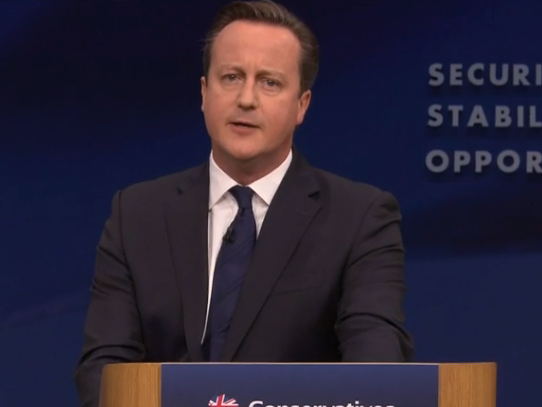
All of these machinations were in danger of overshadowing the real leader of the Conservative party. But David Cameron also confounded expectations by delivering a speech which emphasised tackling poverty as a priority and was more centrist and inclusive than anything heard from him before. Although barely referring to Jeremy Corbyn, Cameron’s words appeared to be a mirror image of the Labour leader’s conference address a week earlier. Where Corbyn omitted any reference to the general election, Cameron had a whole video about it. Where Corbyn marvelled at social media as the communication of the future, Cameron said frankly that the election result demonstrated that ‘Britain was not Twitter’. Corbyn spoke almost exclusively to his party, Cameron consciously addressed the entire country. Seizing back the ‘One Nation’ mantle that Ed Miliband had briefly borrowed, he told the conference that ‘social justice, equality for gay people, tackling climate change and helping the world’s poorest’ were now ‘at the centre of the Conservative party’s mission.’ He then threw in a couple of well-aimed attacks on the Labour leadership on terrorism and economic security just to make sure that swing voters fully understood the perils of voting Labour. Osborne’s speech on Monday had already set up the Tory party as a cosy and welcoming place for them to flee to.
However, despite the overwhelmingly liberal tone, an analysis of the key policy announcement on housing highlights the difference between rhetoric and reality. Cameron claimed his announcement was a dramatic break with the past and implied that it would help ordinary working people. In fact, it was neither radical nor progressive. It is unlikely that a change allowing developers to sell their affordable housing quotas rather than rent them will encourage a huge new wave of housebuilding. Meanwhile, the 20 per cent discount on ‘starter homes’ (worth £250,000 or less outside London) is essentially a subsidy to the better-off. Average-earning families will be priced out of these ‘affordable’ homes in most local authorities by 2020. This means that most people on middle and lower incomes will be just as badly off as they were before, while families on higher incomes will potentially receive an unnecessary government-funded bonus.
If Cameron is really serious about building more houses then he needs to be prepared to completely overhaul planning rules rather than tinker with them. But this would alienate existing homeowners – potential Tory voters – when the beneficiaries will be generally be young people who tend not to vote, and if they do bother, tend not to vote Conservative. Members of parliament in marginal constituencies would almost certainly be actively hostile.
The Tory leadership is currently darting in and out of traditional Labour territory with the impunity of a Russian fighter jet invading Nato airspace. This is something which needs to be of urgent concern to our party. But, before we despair, we need to remember that the Tories, like all mainstream parties, are divided not only on the neuralgic subject of Europe but also on economic and social issues. For instance, Cameron’s lavish praise for diversity was pointedly at odds with own home secretary’s stated views. The Tories’ ability to deviate very far from traditional rightwing policies is seriously hampered not only by having to implement swingeing spending cuts, but also because Cameron only has a majority of 12 – just over half that with which John Major dismally attempted to govern between 1992 and 1997.
The prime minister’s speech revealed a man who is very pleased with himself for having successfully changed his own party, but his tiny majority has not given him anything like the unanswerable endorsement that Tony Blair’s equivalent modernisation project received in 1997 when he achieved a majority of 179. As with the housing policy, there will inevitably be a huge gap between Cameron’s words and what he is really capable of delivering and Labour must be ready to highlight this discrepancy at every turn. But the moderate, credible and inclusive language that Cameron has deliberately employed can only be countered by moderate, credible and inclusive language from the opposition. Heckling from the sidelines never once changed anyone’s mind.
———————————
Christabel Cooper is a member of the Labour party
Remember the old saying “you can fool some of the people all of the time” and 36% of the voting population is enough to keep the Tories in power for another 10 years. This until the economic consequences of their policies are apparent to more than 36% of the voting population. Then what will Labour do? Spend 10 years rescuing the NHS, the schools, police, fire service, etc. until we annoy enough people to be out of power for another 15 years. Something needs to be done to rectify the voting system to prevent minority governments from becoming elected dictatorships.
Hear! Hear! This charade of a “democracy” can’t be allowed to continue without dire consequences. Labour should take the lead in promoting electoral reform – and offer a guarantee that this will be its first act in Government, immediately followed by dissolution of Parliament and a General Election held under the new rules. That should bring all other parties together under a reform agenda and leave the Tories isolated as the only Party seeking to benefit from a grossly unfair, even dangerous, electoral system, only concerned for their own interests.
Given Cameron’s sudden conversion to Social Democracy, should Corbyn offer him a free transfer to the Labour Party?