
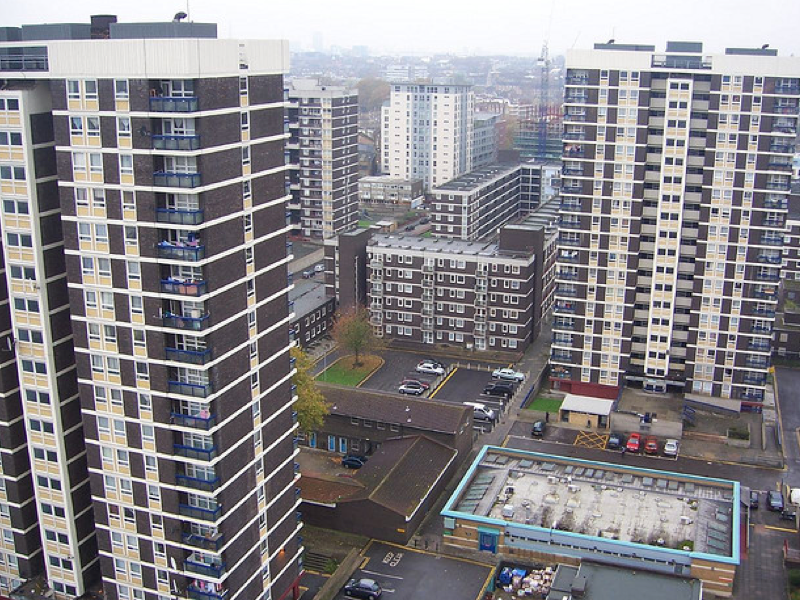
Jeremy Corbyn was right to attack David Cameron on his barely thought through housing announcement. Cameron was right to say that many high rise estates need to be replaced, but we need to challenge the prime minister on his throwaway comment that these estates were built by the post war Labour government before this too becomes another of those ‘new truths’ which are hung around our neck.
Attlee’s government had high aspirations for housing. The houses built and planned under Labour were high quality, with gardens. Popular council estates were the first to be purchased under right to buy because people liked their homes, liked their areas and wanted to stay.
Nye Bevan, housing minister under Attlee, said, ‘We shall be judged for a year or two by the numbers of houses we build. We shall be judged in ten years time by the type of houses we build’. Labour was a bit too ambitious because the speed of the programme made tackling the huge post war housing shortage slow work. Cue the arrival of the Tories. Macmillan made a dash for numbers . Finance was deliberately skewed towards the building of high rise and other large blocks. It was the Tories who stamped on the post war dream of decent housing for all.
Many Labour councils did build these types of flats, following where the grant funding led. So too did many Tory councils. We cannot wash our hands of all responsibility but don’t let Cameron yet again rewrite history
Initially these flats, with central heating, new kitchens and bathrooms were welcomed by many tenants. So what went wrong? Partly the building fabric, much of it not resilient to British conditions. Three Edinburgh blocks, built in 1961-62, were demolished in the early 2000s after suffering severe damp problems from day one.
Nor was there any understanding of the real costs of maintaining and sustaining these buildings. Sometimes critics of councils point out that there are many luxury private high rise buildings which ‘work’. But owners and tenants there pay a hefty service charge to cover regular repairs and maintenance, lifts, security and care of the surrounding landscaped ground. Councils built these homes because they were cheap to build but no-one seemed to realise that ongoing maintenance costs would be very high. A few years ago in Edinburgh we worked out that high rise rents would double if the full costs of repair, maintenance and management were charged to these flats alone instead of being spread across the entire housing stock.
Cameron’s claim is that replacing such homes would be good not only in housing terms but would transform lives, eliminate anti social behaviour and poverty. Well on one level it would certainly transform an area if all the poorer people get moved somewhere else!
However I think there is plenty of experience to suggest that certain house types are associated with high levels of deprivation, anti social behaviour and crime. Public space – garden ground, lifts, stairs, landings – are everybody’s and nobody’s.
Changing the style of housing can help. When I was a councillor I saw a graphic but simple example of this in my ward. A row of terraced 1960s properties, some bought some not, had open plan front ‘garden’ areas, where some people tried putting out plants but gave up when neighbourhood dogs and children roamed across the public space. Council staff eventually agreed to my suggestion that the front areas be fenced in at council expense. Within one season virtually all the residents rose to the challenge and created gardens where once there was space. Less cost to the council annually and a much pleasanter environment all round.
But – and it is a big but – if housing is all that is changed, levels of poverty and deprivation may change little. An evaluation of extensive regeneration in the Wester Hailes area of Edinburgh in the 1990s, found that levels of unemployment were actually higher at the end of the process than at the beginning. Education, training, job opportunities all need to be worked on.
Any government serious about regeneration could learn a lot from the work done by Labour’s Social Exclusion Unit which published volumes of research and action plans outlining the complexities and interrelationships of attempting to tackle what is a multi dimensional problem. That included recognising that if communities were to work well, basic things like crime and anti social behaviour needed to be addressed with good community policing, community wardens and firm action. It recognised that children’s performance in schools would only be improved if good opportunities existed from the beginning – Sure Start was all about that. The reports of the Social Exclusion Unit are available at the National Archives and the British Library. Go look them up, and, as Peter John Labour leader of Southwark Council said, go learn from what many Labour councils have done and are still doing on the ground.
Does regeneration always have to reduce the proportion of affordable housing? Sometimes changing the tenure mix is important to help break down outdated ideas about good and bad areas, provide a wider social mix for local schools and build a stronger base for local facilities and businesses. Labour does not stand for ‘ghettos of deprivation’ as Cameron insinuated. Bevan in the 1940s stressed the need for mixed communities. What we need to ensure is that in the process we do not lose low rent affordable homes overall, even if they are not all built in exactly the same place.
But equally in some areas it is right to replace low rent housing fully. That has a substantial cost but it can and has been done. The Labour council and Labour led administration at Holyrood prior to 2007 funded demolition, rebuilding and refurbishment in parts of Edinburgh with numbers of low rent homes kept to previous levels. The immediately surrounding area already had high levels of home ownership so providing a mix of tenures was not essential
Regeneration does not come cheap. The relatively small Moredun and Hyvots regeneration in Edinburgh took 10 years and cost £67m, of which half came from government grant. Regeneration which seriously addresses disadvantage in all its aspects requires even more investment. That is why Cameron’s ideas do not stack up. We need to keep saying this, and reminding people of the different approach of the last Labour government and current Labour councils.
———————————
Sheila Gilmore is former member of parliament for Edinburgh East. She tweets @SheilaGilmore49
———————————