
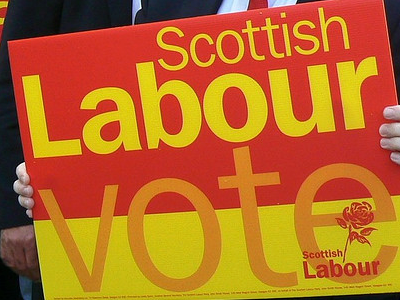
The BBC has been leading its news that the election in Holyrood has been a disaster for Scottish Labour.
Even I, as a serial Labour loyalist, cannot pretend that the result has been good for us.
However, there are more conclusions to be drawn and lessons to be learned and, although immediately after is not the best time to do so, here goes.
The Scottish National party is claiming this as a historic victory – but that is another of its typical hyperboles. Nicola Sturgeon has failed to achieve the overall majority that the more abrasive Alex Salmond did in 2011. That is the biggest story out of Scotland today.
But we need to look at why we have been overtaken by the Tories in Scotland, of all places, and have the worst result for a century.
Our decline has not been in the last few weeks, months or even years, but over the past few decades, so Kezia Dugdale should not be blamed.
It has resulted from complacency, arrogance, indolence and some bad luck.
Some of our members of parliament took victory for granted and did not work hard in their constituencies. It is salutory to note that the MP who had the smallest majority in 2010, Ian Murray, worked hardest and was the only one to hold his seat in 2015, and we won the Holyrood seat from the SNP yesterday.
But the death of Donald Dewar was one of our pieces of ill-luck. Later, in 2007, an election dogged by administrative mistakes in the count, surprising SNP gains in regional lists and an adroit Salmond coup over a stunned Jack McConnell started the SNP bandwagon.
Then we have had a series of leaders, dogged by various problems, some of their own making, which has denied us any continuity and consistency of leadership.
Meanwhile, the SNP has been building its strength, sustained by the cash of Brian Souter and the EuroMillions winners, but also a slick and effective administrative machine, and the Tories have been rebuilding under effective leadership.
Kezia has been a strong but personable leader but has not had the time to get both her personality and leadership over to the people of Scotland. We now need to reaffirm her position as leader so she has the time to become liked and respected by the electorate as she is by those of us who know her well.
I hope she will forgive me making public one piece of advice I held back during the campaign. We did not acknowledge that the constitution was still an issue in the way the Tories did.
Privately I have been arguing that we should be offering a positive alternative for the constitution of the United Kingdom which is stable, comprehensive and coherent and different from the separation of the SNP.
A federal or quasi-federal UK is my own preference but a convention which consults widely throughout the UK is the way we should move forward as we did in establishing the Scottish parliament.
With a leader of the calibre and charm of Kezia establishing herself over the next few years, an anti-austerity programme and a real alternative to separation we can not only build for victory in Holyrood in 2021 but also hold our position in council elections in 2017 and contribute towards a UK Labour majority in the UK in 2020.
———————————
George Foulkes is a member of the House of Lords and a former member of the Scottish parliament. He tweets @GeorgeFoulkes
———————————
Instead of a pan-Divided kingdom convention (are you sure there was such a thing prior to setting up the Scottish Parliament?), why not just ask the voters of England how we want our country to be governed? Nobody outside England should have a say in the matter, as we never had a say in the other countries’ business. Considering we all have the same citizenship, we should have the same say in self-determination. Or would that be a bit too democratic for some people?
In my opinion this contribution has set the right tone and raises the correct issues. Although I do acknowledge the need to raise attention to the UK’s largest nation. The Scottish Labour story was a long time in the making, as I think we are yet to see in England – the neglect of the interests of its core supporters at the expense of centrally driven ‘vision-makers’ over the last decade or more. Whatever the merits or otherwise of the EU arguments, Labour’s almost complete compliance to the existing EU vision, will I suggest, demonstrate its alienation of the Party from its ‘taken-for-granted’ supporters in England – post referendum.
We should extend the approach and tone of the above contributor to Corbyn’s role in England. After only 8 months of office, little time get policy formulation and democracy moving, combined with internal destructive distractors, hell bent on ‘leading’ the Tory onslaught and providing media opposition copy, again and again, on an almost daily basis election results have stabilised a long term decline. It is difficult for Corbyn to shut these irreconcilables up without seeming overbearing, so I would hope those who are able to communicate with them, would use more elbows, to act as daily reminders.