
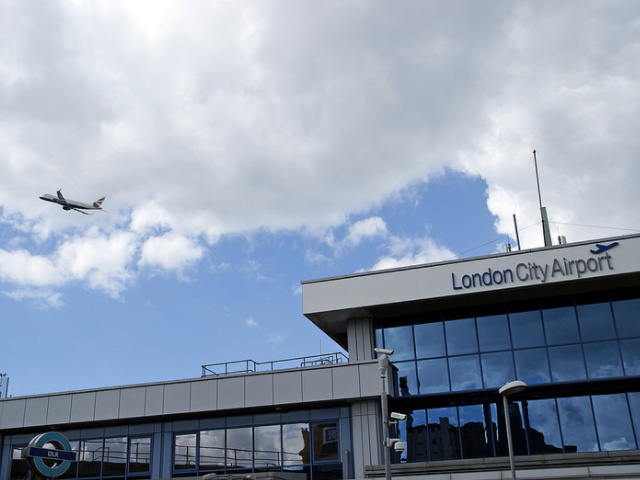
Over the past thirty years, the growth of London City Airport has brought more jobs and prosperity to east London – and allowed it to invest in the community, writes Liam McKay
2017 marks the 30th anniversary of London City Airport’s operation. In 30 years the airport has changed and so have the areas around it.
Areas, and their future success, are defined by pivotal moments. For east London, there have been many, with the Olympics being the most seismic in recent memory. For London City Airport it was the DLR. In 2005, when it was opened by Ken Livingstone, it changed the airport from something that was hard to access, to an integrated part of the London transport system.
That success triggered more airlines, more passengers and, crucially, more jobs and investment.
LCY is both a business in its community and a business of its community; 68 per cent of its 2100 employees come from within 5 miles of the airport and 42.5 per cent of all operational and capital contracts (with a value of £34.5 million) go to east London businesses.
We are also investing in the education and aspiration of local students. In 2016, 4241 east London school children participated in LCY’s education programmes. And, the airports award winning employment partnership with Newham, ‘Take Off Into Work’, employed its 600th resident.
We have a comprehensive corporate social responsibility agenda because not only is it good for the area but because it is manifestly good for business as a resilient business is a locally resourced one.
The airport is now on the cusp of another pivotal moment in the shape of the City Airport Development Programme. It is a c£400 million investment in a world class airport for east London. An airport that will be able of welcoming the next generation of aircraft, connect to established and emerging markets as far away as the Gulf and North America and it will double our workforce. One such cutting edge aircraft is the Bombardier CSeries, which LCY welcomed into commercial operation in August. This aircraft represents the future of aviation from the airport; its verifiably quieter, more fuel efficient and can accommodate more passengers and fly further distances.
As we grow it will create opportunities for east London and east Londoners. In the year ahead we will promote the job opportunities we are creating and will hold our first ever meet the buyer event. But more than that, we want to work with our partners. Boroughs and community groups know their areas and the challenges and opportunities that exist. We welcome creative conversations and the opportunities to invest in programmes that will inspire and upskill local people.
But a crucial challenge, for all of us, will be ensuring we link growth areas with transport links. According to the Local London boroughs, there is the potential for 260,000 new homes and 200,000 new jobs in their boroughs by 2038. It is clear that many of the answers to city issues and demographic challenges can be found in east London. However, to capitalise on the potential we need to join the dots. The Elizabeth line is a great start, as is growth at London City and the Silvertown Tunnel. More will be needed though. That is why, with partners, we have made the case for more river crossings in east London to link north and south, to upgrade the A12 and A13 to alleviate gridlock and to invest in more capacity for the DLR.
We also believe there should be a Crossrail station at London City Airport. It is possible and it would benefit the communities of North Woolwich, spur regeneration and link our airport and passengers with other airports in the London system. We will continue to make the case, and we hope, with the support of our partners.
Lastly, the airport will grow sustainably and considerately. There are concerns but we will continue to proactively manage and mitigate our environmental impact. We offer one of the most comprehensive sound insulation programme in the country, we are a zero landfill business, and, moving forward, we aspire to become a carbon neutral airport. Also, from next year, LCY will operate an incentives and penalties system for aircraft that exceed stated noise limits.
Our market leading proposition attracts investment. That has been true in London’s Royal Docks as well as areas that are directly connected to the airport. Now the challenge is to unlock the potential that abounds in East London by both maximising the benefits of our development and connecting growth areas to key transport hubs.
We believe we can be not only the airport for east London, but also the airport that supports the communities of east London.
––––––––––
Liam McKay is director of public affairs at London City Airport.
Join Progress and London City Airport at Labour party conference in Brighton for: ‘Learning lessons: Thirty years on, what can the story of East London teach us about encouraging trade and regeneration in our communities?’ at 12.45pm, Monday 25 September.
––––––––––